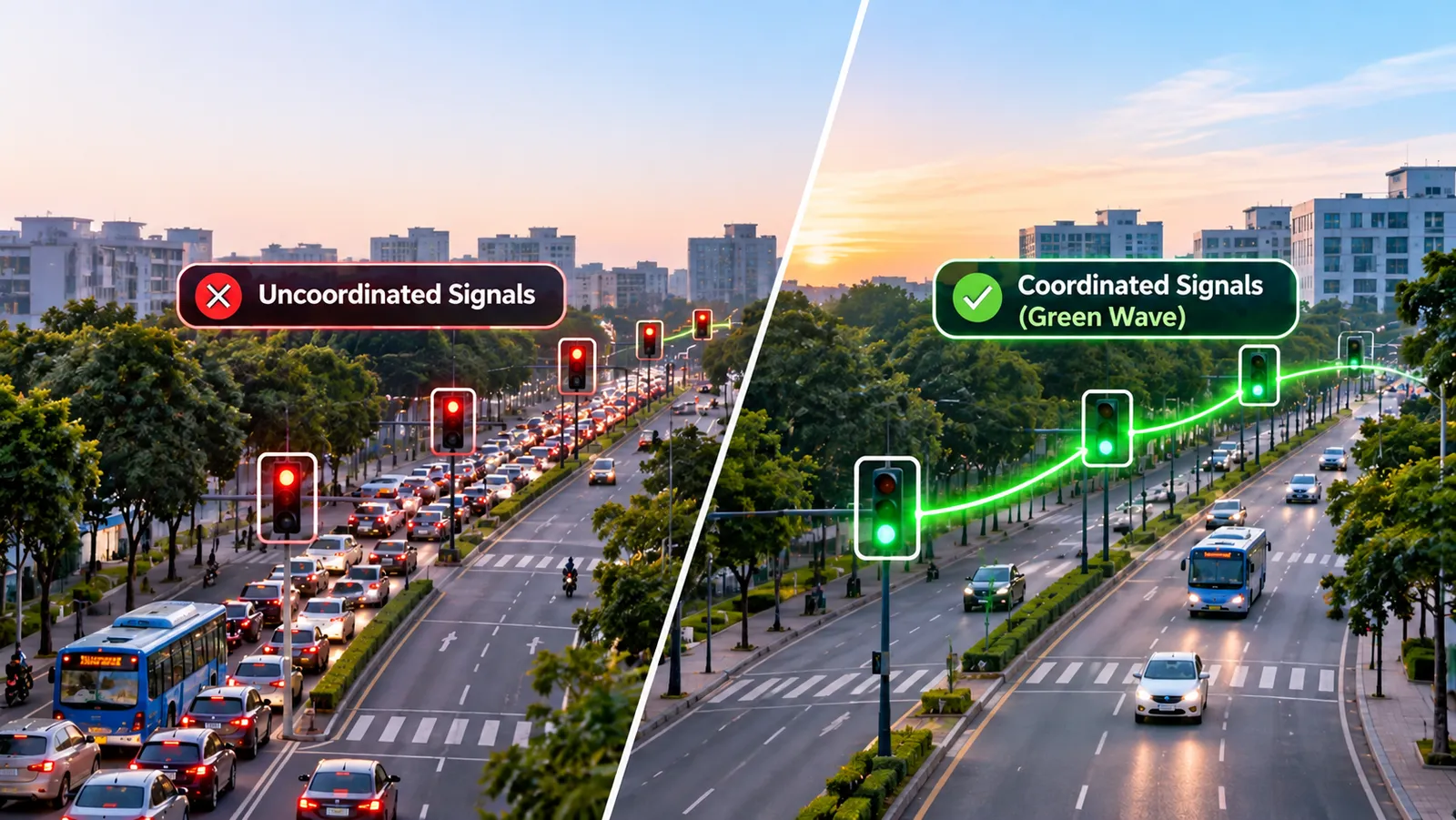
You have probably experienced this situation. You get a green light at one junction, move ahead, and within a minute you are stopped at another red light. The next signal turns green, but the queue ahead is still moving slowly. By the time you reach the following junction, the light has changed again.
Now imagine this happening across an entire stretch of road during peak hours.
Each traffic signal may be doing exactly what it was programmed to do. Yet the overall journey is still slow. The problem is that traffic does not move one intersection at a time. Vehicles released from one junction become the traffic arriving at the next.
This is why managing traffic signals individually is not always enough. In busy urban areas, signals need to work together as part of a wider road network.
The Problem with Managing Every Junction Separately
A traffic signal controls the movement of vehicles and pedestrians at an intersection. It decides when one direction can move and when another must wait. At an isolated junction, the timing can be designed around the traffic volumes and movements at that particular location.
But roads are connected. A junction rarely operates independently of the intersections around it.
Consider a busy road with four traffic signals spaced a short distance apart. During the morning rush, the first signal releases a large group of vehicles. Those vehicles travel towards the second junction, where another signal is operating on its own timing cycle.
If the second signal turns red just as the vehicles arrive, a queue begins to form. The same thing can happen at the third and fourth junctions. What started as a smooth movement from the first signal gradually turns into repeated stopping and waiting.
In some cases, the queue becomes so long that it blocks the previous intersection. Vehicles that could otherwise move are left waiting because there is no space ahead.
This is known as queue spillback, and it can turn a local traffic problem into a much larger one.
What Is Coordinated Traffic Signal Control?
Traffic signal coordination is the practice of adjusting signal timings across multiple intersections so that vehicles can move more smoothly along a road corridor.
One familiar example is the green wave.
Imagine several signals along a straight road. Instead of giving each junction an unrelated green phase, engineers coordinate the timings based on the distance between signals and the speed at which vehicles are expected to travel.
When the first signal turns green, a group of vehicles moves forward. The next signal is timed to turn green around the time that group reaches it. If the timings and traffic conditions are suitable, vehicles can pass through several intersections with fewer stops.
This depends on three important factors:
- Cycle length: The total time required for a signal to complete one full sequence of phases.
- Green split: How much of that cycle is allocated to a particular traffic movement.
- Offset: The time difference between the start of a signal's cycle and the corresponding cycle at another intersection.
Getting these timings right requires more than setting every signal to the same schedule. Engineers need to consider road distances, vehicle speeds, traffic volumes, turning movements and the direction of peak-hour demand.
A green wave is also not a promise that every vehicle will pass through every signal without stopping. Traffic conditions, turning vehicles, pedestrian crossings and queues can all affect the result.
Why Fixed Timings Do Not Always Work
A coordinated signal plan can work well when traffic follows a reasonably predictable pattern. The difficulty is that city traffic rarely behaves exactly the same way every day.
A road that carries heavy traffic towards the city in the morning may experience the opposite movement in the evening. A school closing, a public event, road construction or an accident can suddenly change traffic volumes at a junction.
A fixed timing plan may continue allocating green time based on conditions that no longer exist.
For example, a signal might give a busy main road a long green phase even when traffic on that approach has temporarily reduced. Meanwhile, vehicles on a side road continue waiting despite having enough space to move.
This is where adaptive traffic signal control becomes useful.
Unlike a fixed schedule, an adaptive system uses traffic information collected through sensors and other detection equipment to adjust signal timings as conditions change. It can respond to variations in demand rather than relying entirely on timings prepared in advance.
Signal coordination and adaptive control are not the same thing. Coordination establishes how signals work together across a corridor. Adaptive control adjusts their operation in response to changing conditions. They can also be used together.
Why Traffic Data Matters
Good signal timing starts with understanding what is actually happening on the road.
Traffic engineers need to know how many vehicles approach an intersection, which directions experience the longest queues, how much time vehicles spend waiting and whether congestion is building up between junctions.
Without reliable information, signal timing decisions can become guesswork.
Traffic sensors, cameras and vehicle-counting systems provide useful inputs. Historical traffic data can reveal recurring peak-hour patterns, while live monitoring helps operators identify unusual conditions.
For instance, if a particular junction regularly develops long queues between 6 PM and 8 PM, engineers can examine its traffic movements and review whether the existing signal plan is suitable. If a nearby intersection is also affected, the solution may need to consider both junctions rather than changing the timing of just one.
It is equally important to monitor what happens after a signal plan is changed. Fewer stops at one intersection do not necessarily mean the entire corridor is performing better. The improvement needs to be measured across the wider stretch of road.
Coordination Is Not Just About Moving More Cars
There is another important consideration: a road network has to serve different types of users.
Pedestrians need sufficient crossing time. Buses may need priority at certain junctions. Emergency vehicles must be able to respond quickly, and traffic from smaller connecting roads should not be left waiting indefinitely.
A signal plan that gives maximum green time to the busiest road may improve vehicle flow in one direction but create unacceptable delays elsewhere.
Traffic engineers therefore need to balance several objectives, including travel time, queue length, pedestrian safety, public transport movement and access to side roads.
The best signal plan is not necessarily the one that moves the largest number of vehicles through a single junction. It is the one that manages movement across the network without creating new problems at neighbouring intersections.
The Role of Intelligent Traffic Management Systems
Coordinating traffic across a city requires more than installing smart signals. Authorities need visibility into traffic conditions, road incidents, vehicle movement and the performance of individual locations.
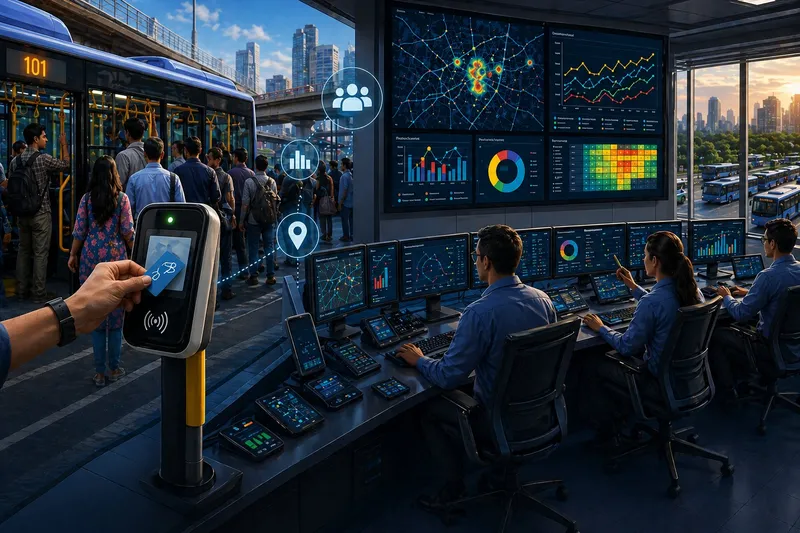
An Intelligent Traffic Management System (ITMS) brings important traffic information and operational tools into a connected environment. Operators can monitor road conditions, examine traffic patterns, identify congestion hotspots and coordinate responses through a central command and control setup.
Arena Softwares' ITMS brings together capabilities such as Geographic Information System (GIS), traffic monitoring, vehicle analytics, incident management and traffic planning and analysis. These capabilities can help authorities understand how traffic conditions change across different locations and make better-informed operational decisions.
For signal coordination programmes, this kind of network-wide visibility is valuable. It helps traffic teams look beyond an individual junction and consider how changes at one location affect the surrounding road network.
Better Traffic Flow Starts with Better Coordination
A traffic signal can do its job perfectly and still contribute to a frustrating journey if it is not considered alongside the signals around it.
As cities grow and vehicle movement becomes more complex, managing intersections in isolation becomes increasingly difficult. Coordinated timing, reliable traffic data and adaptive control can help authorities respond to the way traffic actually moves through a city.
The goal is not simply to make every light turn green more often. It is to make sure that vehicles, pedestrians and public transport can move through the network safely and with fewer unnecessary delays.
At Arena Softwares, we believe better traffic management starts with better visibility and coordination. Our Intelligent Traffic Management System brings traffic monitoring, analysis and incident management together to help authorities make informed decisions across their road networks. Explore Arena Softwares' ITMS solutions to see how connected traffic management can support smarter urban mobility.

Comments
0 messagesLeave a comment
Your email won't be published. Anonymous commenters can skip both name and email.