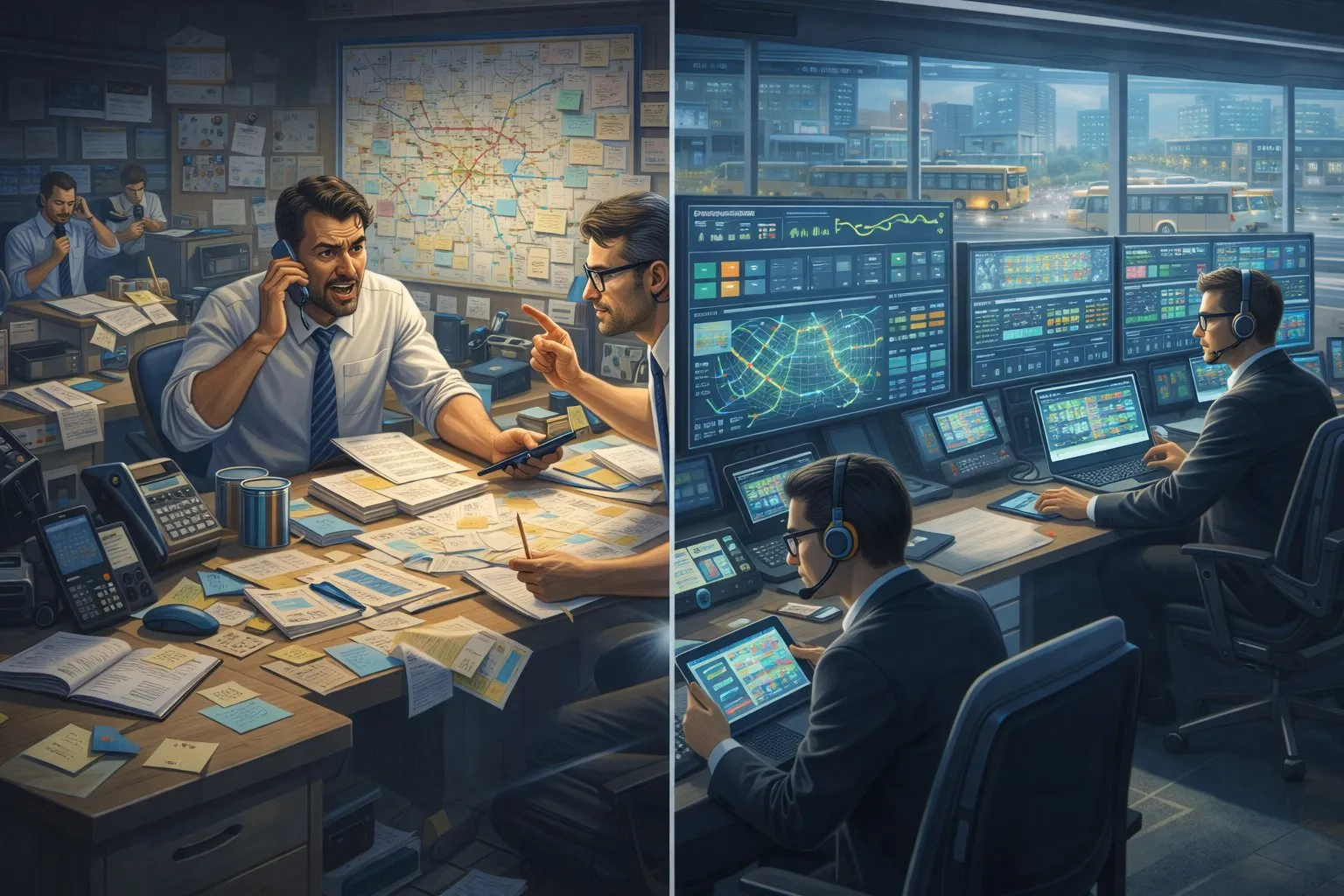
Managing a public transport dispatch system is often one of the most demanding parts of running a bus network. While passengers mainly notice buses arriving at stops, the real work of keeping services balanced happens behind the scenes in the dispatch room.
If you ask someone who manages a bus network what the hardest part of the job is, the answer usually isn’t what people expect.
It’s not always the buses. It’s not even the routes. More often, the real challenge is keeping everything coordinated once vehicles are already out on the road. Traffic slows down unexpectedly. A driver reports that a vehicle is overheating. A bus that should have left a stop five minutes ago is still stuck behind congestion. From the passenger’s perspective, the delay seems random. From the dispatch room, it’s a chain reaction waiting to happen.
That’s why dispatch teams are so important in public transport operations. They’re the people trying to keep the network balanced while the city around it constantly changes. For many years this work was handled manually. Radios, phone calls, and spreadsheets were the tools dispatchers relied on every day. It worked—up to a point.
But as transport systems grow larger and cities become more complex, many agencies are discovering that manual dispatch alone isn’t enough anymore.
The Reality of Manual Dispatch Systems
Manual dispatch systems usually develop gradually. They are rarely designed as a formal bus dispatch management system from the beginning. A depot might start with a handful of routes and a small fleet. Dispatch supervisors communicate with drivers through radio updates. Schedules are tracked on spreadsheets or printed sheets pinned to the wall.
When something goes wrong—say a bus is delayed or breaks down—the driver calls the dispatch room. The dispatcher figures out the next step, often by calling another driver or checking which vehicles are nearby. For smaller operations, this approach can work quite well. Experienced dispatchers often know their network inside out.
The challenge appears when the network grows. A city with hundreds of buses running across multiple routes generates far more information than a dispatcher can easily track through calls and notes. Small disruptions start to pile up quickly. By the time dispatch teams understand what is happening on one route, another part of the network may already be experiencing delays.
Without real-time fleet monitoring, dispatchers often end up reacting to problems rather than preventing them.
What Changes When Dispatch Becomes Digital
Digital public transport dispatch systems don’t eliminate the role of the dispatcher. In fact, they make the job easier by giving teams better visibility. Instead of gathering information from different sources, dispatchers can see the entire fleet on one dashboard. Vehicle locations, route progress, and schedule adherence are visible in real time.
This kind of overview helps transit control centers spot problems earlier. For example, if a bus suddenly stops moving for several minutes, the system can highlight it immediately. Dispatchers can then check whether the vehicle is stuck in traffic, experiencing a technical issue, or waiting longer than expected at a stop.
Having that information early allows teams to decide how to respond before delays spread further across the route. Solutions like RouteSync from Arena Softwares, a digital public transport management platform, help transport agencies create these modern transit control centers, where fleet tracking and route monitoring are managed through a single system.
Why Early Awareness Makes a Big Difference
One thing many operators notice after adopting digital dispatch tools is how much earlier they can see potential problems. In manual systems, dispatchers often learn about disruptions only after drivers report them. By that time, the situation may already be affecting passengers waiting further along the route.
With real-time bus fleet monitoring, small changes become visible sooner. A vehicle that slows down unexpectedly. A route that begins losing its planned headway. A bus that stays stationary longer than usual. These signals give dispatch teams a chance to react before the disruption becomes more serious.
Sometimes the solution is simple—sending another vehicle into the corridor or adjusting the schedule slightly to restore balance.
Why Drivers and Passengers Notice the Difference
Better dispatch systems improve more than just the control room.
Drivers benefit because communication becomes clearer. Instead of relying entirely on radio updates, dispatch teams can coordinate instructions more effectively. Passengers benefit as well. When dispatchers can see what’s happening across the network, they can respond faster to delays and keep services more consistent.
Over time, that leads to something every passenger appreciates: more predictable waiting times and better public transport reliability.
A Shift That Many Cities Are Already Making
Public transport networks are growing in size and complexity. Managing hundreds of vehicles across busy urban roads requires better operational awareness than manual systems can easily provide.
That’s why more transit agencies are investing in digital transit control centers. Platforms like RouteSync, powered by Arena Softwares, help operators bring together vehicle tracking, route monitoring, incident alerts, and dispatch management into one environment.
For many cities, this shift isn’t simply about adopting new technology. It’s about giving dispatch teams the tools they need to keep the network running smoothly.
Final Thoughts
Passengers rarely see what happens inside a dispatch room, but those decisions quietly shape how reliable public transport feels every day. When dispatch teams have clear visibility of the network, they can respond faster, balance routes more effectively, and prevent small disruptions from turning into bigger problems.
In a busy urban transit system, that kind of awareness can make all the difference.
If your organization is exploring ways to modernize dispatch operations, you can request a control center mockup demo from Arena Softwares to see how RouteSync helps transit agencies monitor fleets and manage routes in real time.
Comments
0 messagesLeave a comment
Your email won't be published. Anonymous commenters can skip both name and email.