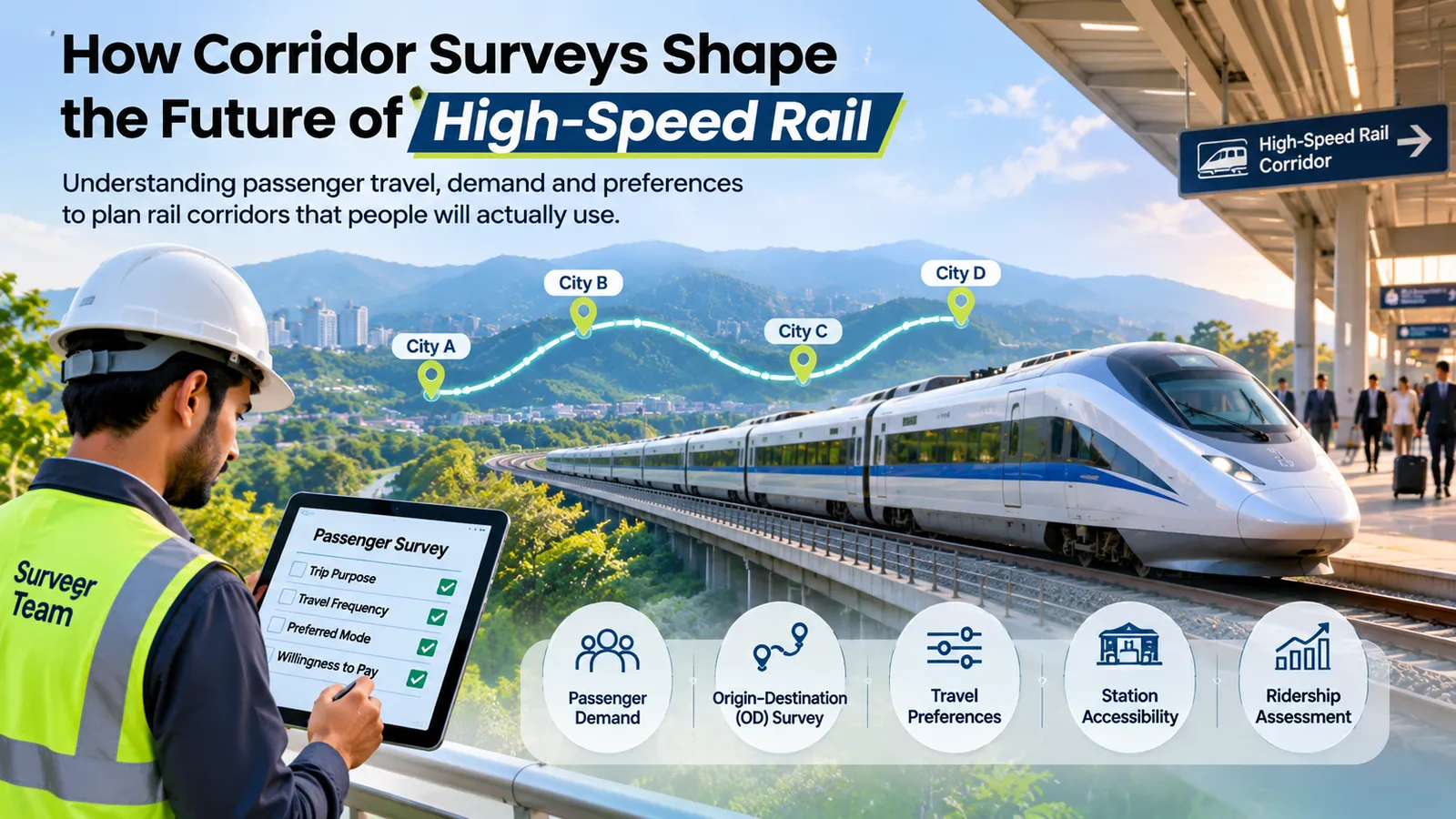
Imagine a passenger living in a smaller town who needs to travel to a major business city. The journey might involve a bus, a conventional train and another short ride to reach the final destination. Now imagine a high-speed rail network being planned in that region. Would this passenger use it? Which station would they travel from? How much time and money would they be willing to spend?
These are the kinds of questions that need answers before a high-speed rail project moves forward.
Building a bullet train corridor is a major investment. Choosing its route, identifying station locations and estimating passenger demand cannot depend on assumptions alone. Authorities need to understand how people travel today and what could make them choose a new service tomorrow. Corridor surveys provide much of the information needed to make those decisions.
A Railway Route Should Follow Travel Demand
When a new high-speed rail corridor is proposed, the first instinct may be to connect the biggest cities along the route. That sounds reasonable, but the distance between two major cities does not automatically tell us how many people will travel between them.
A city might have a large population but relatively little daily travel demand towards the next proposed station. Another smaller town could have strong connections to business districts, industrial areas or educational centres along the corridor.
This is why understanding existing travel patterns matters. Surveys can reveal where passengers are travelling from, where they are going, how frequently they make the journey and why they travel.
For example, weekday travel may be driven largely by business and employment, while weekend journeys may be more closely connected to tourism and family visits. These differences matter when estimating demand and deciding what kind of service passengers might need.
Following the Journey with Origin–Destination Surveys
One of the key methods used in transport studies is the Origin–Destination (OD) survey.
Rather than looking only at the station where a passenger boards and the station where they get off, an OD survey examines the wider journey. Where did the passenger start? Where are they going? Did they use another transport service before reaching the station? How often do they make this trip?
Take a passenger travelling from a town outside a major city. They may spend 30 minutes on a feeder bus before reaching the railway station. After arriving at their destination, they might need another 20-minute journey to reach their workplace.
Recording only the train journey would give an incomplete picture of their travel experience.
When similar information is collected across a proposed corridor, researchers can identify major passenger movements, travel connections and locations that may need better transport links. This gives authorities a stronger basis for evaluating station locations and understanding the wider catchment area of each station.
Would People Actually Pay for a Faster Journey?
A high-speed train can save considerable travel time, but passengers still have to decide whether that saving is worth the ticket price.
A business traveller making frequent trips might be happy to pay more to arrive earlier. A family travelling occasionally may prefer a cheaper conventional train, even if the journey takes longer. Someone living far from the proposed station may not find the service particularly convenient.
This is where stated-preference surveys become useful.
Instead of asking only about existing travel habits, researchers present passengers with possible travel choices. They might compare a high-speed train with a higher fare against a conventional train with a longer journey time. Other questions can explore preferred departure times, service frequency and station accessibility.
The responses help researchers understand what passengers value and how they might respond to different service and pricing options.
After all, a railway service needs passengers, not just impressive journey-time figures.
The Station Location Is Only Half the Story
There is little benefit in saving an hour on a train journey if passengers spend most of that time trying to reach the station.
Station accessibility is an important consideration in high-speed rail planning. A proposed station might be located outside a city to accommodate railway infrastructure, but passengers still need convenient ways to get there.
This raises several practical questions. Are there residential areas nearby? How far are the major employment centres? Can existing buses or metro services connect to the station? Will passengers need parking facilities? Are taxis and other local transport options readily available?
Surveys can help answer these questions by recording passengers' current access and departure journeys, preferred transport modes and expected station access requirements.
The findings can inform feeder bus planning, metro integration and other first- and last-mile connections. Without this wider view, a fast railway service could still leave passengers with a difficult journey at either end.
Getting Reliable Information from the Field
A large corridor study is rarely completed from a single location. Survey teams may need to work across several cities, towns, stations and transport hubs. They also need to ask consistent questions and collect information in a format that can be compared later.
This is where the process can become challenging.
If some teams use paper questionnaires while others maintain separate spreadsheets, bringing everything together can take considerable time. Missing responses, incorrect entries and unclear survey locations can create additional work during data cleaning.
Digital data collection makes the process easier to organise. Field staff can work with structured questionnaires, receive assigned survey locations and submit responses directly through a digital platform. GPS coordinates and photographs can also provide useful context for certain types of surveys.
Offline collection is particularly helpful when teams are working in locations with unreliable internet access. Responses can be synchronised when connectivity becomes available.
The quality of the final analysis still depends on good questionnaire design, appropriate sampling and proper validation. Technology helps manage the collection process, but it does not replace sound survey methodology.
Bringing Corridor Survey Activities Together with RouteSync
Managing questionnaires, field teams and responses across multiple locations calls for a system that keeps the work organised.
RouteSync, a product by Arena Softwares, includes digital survey management capabilities for transport-related studies. Its survey offerings cover household, employee, boarding–alighting, stated-preference and infrastructure surveys. The platform also includes a high-speed rail corridor ridership survey template.
Survey teams can use configurable forms, field assignments, GPS and photo capture, offline data collection and survey data management capabilities. These features provide a digital way to organise field activities and bring collected responses together.
For transport authorities, consultants and research organisations preparing high-speed rail studies, RouteSync offers capabilities that can support the collection and management of passenger and corridor survey data.
Better Rail Planning Starts with Better Questions
A high-speed rail network is built to serve people, but understanding their needs has to happen long before the first train enters service.
Where will passengers travel from? Which cities have the strongest travel connections? What fares will people accept? How will they reach the stations? These questions deserve proper attention during the planning stage.
The answers can influence route selection, station planning, ridership estimates and the transport connections surrounding the railway.
Planning a high-speed rail or bullet train corridor survey? RouteSync by Arena Softwares brings survey design, field assignments and digital data collection capabilities together to help your team manage the process. Explore RouteSync to see how it can support your next transport survey project.



Comments
0 messagesLeave a comment
Your email won't be published. Anonymous commenters can skip both name and email.