
Cart is empty
Why Public Transport Networks Fail at the Edges: The Science of Network Resilience
31/08/2026
A public transport network can appear to work perfectly on a normal day. Buses are running, metro trains are operating, depots are dispatching vehicles, and passengers are moving between different services without much difficulty.
Then something unexpected happens.
A major road is blocked. A metro station has to close temporarily. Several buses become unavailable. A bus terminal becomes overcrowded. An electric bus depot experiences a charging problem.
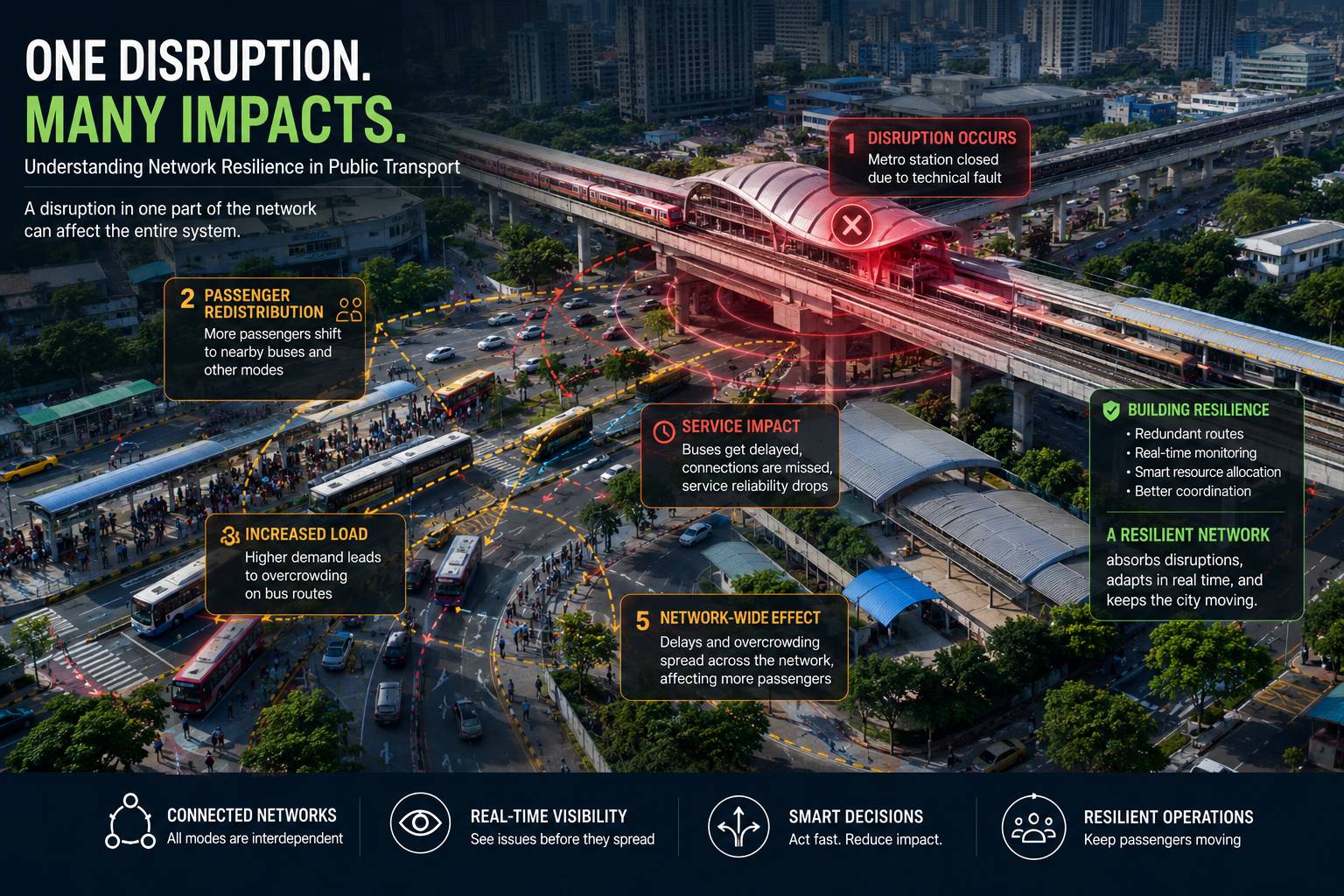
At first, the problem may appear to be limited to one location. But in a connected transport network, disruptions rarely behave that simply. Passengers begin looking for alternative routes, nearby services receive additional demand, boarding times increase, buses become delayed, and connections start to break down. What started as a local disruption can gradually affect a much larger part of the network.
This is where the concept of transport network resilience becomes important.
What Is Transport Network Resilience?
In simple terms, resilience is the ability of a transport system to continue providing essential services when something goes wrong, adapt to changing conditions, and recover after the disruption.
Resilience is slightly different from reliability.
Reliability is primarily concerned with how consistently a system performs under normal conditions. Resilience asks a different question: What happens when normal conditions disappear?
A bus network may have excellent punctuality on an ordinary weekday, but that doesn't necessarily mean it is resilient. A resilient network should also have enough flexibility to respond when vehicles become unavailable, roads are blocked, passenger demand suddenly changes, or an important interchange is disrupted.
This distinction is becoming increasingly important as cities develop more interconnected transport systems. Modern journeys often involve several services, such as walking to a bus, transferring to a metro, and then using another bus or micromobility service to reach the final destination.
The more connected the network becomes, the more important it is to understand how a disruption in one part can influence another.
Why Some Parts of a Network Are More Important Than Others
Not every location in a transport network has the same importance.
Consider two bus stops. One may serve a small residential street with only a single route passing through it. Another may be located next to a major railway station where several bus routes connect with a metro line.
If the first stop becomes unavailable, passengers may have relatively easy alternatives. If the second location becomes unavailable, thousands of passengers could suddenly need to find another way through the network.
This is why transport researchers study concepts such as network centrality, critical nodes, and redundancy.
A location can become critical because many routes depend on it, because it connects otherwise separate parts of the network, or because passengers have very few alternatives when that connection is lost.
Interestingly, the most critical location isn't always the one with the highest passenger volume. Its importance can also depend on how many alternative connections exist elsewhere in the network. Recent research into land transport networks has examined how network structure and alternative connectivity influence the severity of disruptions.
How a Small Disruption Can Become a Large Problem
Consider a metro station that has to close temporarily during the morning peak.
The passengers who normally use that station still need to get to their destinations. Some may walk to another station, while others may use buses, taxis, or other available services.
Now imagine that a large number of those passengers move onto nearby bus routes.
A route that normally operates comfortably may suddenly become heavily loaded. More passengers mean longer boarding and alighting times. The buses spend more time at stops, departures become less predictable, and the vehicles begin arriving late at subsequent stops.
The original metro disruption has now created a problem for the bus network.
This is an example of a cascading effect. A disruption changes passenger behaviour, that behaviour changes demand elsewhere in the network, and the resulting pressure can create additional operational problems.
Research into interconnected public transport systems has examined this type of disruption propagation, including the relationship between passenger redistribution, network structure, and available capacity.
Passengers Are Part of the Network
One of the most important things to understand about public transport resilience is that a network is not made up only of buses, trains, roads, and stations.
Passengers are part of the system too.
When a service is disrupted, passengers make decisions. They may change routes, transfer at a different station, use another mode, or postpone their journey. Those decisions change demand across the rest of the network.
This can create a feedback loop.
A cancelled service pushes passengers onto another route. That route becomes more crowded. Crowding increases boarding time. Longer boarding causes delays. Those delays encourage even more passengers to look for alternatives.
This is why predicting passenger behaviour during disruptions is an important part of resilience planning. Research on urban rail systems has increasingly incorporated passenger transfer and route-choice behaviour when examining how disruptions spread through a network.
Why Redundancy Matters
One of the strongest ways to improve resilience is to provide reasonable alternatives.
Imagine that passengers have two practical ways to travel between two major areas. If one route becomes unavailable, the second can absorb at least some of the demand.
Now imagine that there is only one practical connection. If that connection fails, there is very little flexibility left.
This is known as redundancy.
Redundancy does not necessarily mean building duplicate infrastructure everywhere. It means ensuring that important passenger movements have alternative paths when part of the network is disrupted.
Research on public transport network design has found that greater path redundancy can improve the ability of a network to continue serving passengers during disruptions.
For growing cities, this creates an important planning question: How much efficiency should be sacrificed to maintain enough flexibility when something goes wrong?
The Balance Between Efficiency and Resilience
Transport operators naturally want to use their resources efficiently.
An unused bus may appear inefficient. A spare vehicle sitting at a depot may seem like an unnecessary expense. Running a route with additional capacity during normal conditions can also be difficult to justify.
But a network operating at almost full capacity has very little room to absorb unexpected events.
If one vehicle becomes unavailable, another may have to be removed from a different service. If one route is disrupted, there may be no spare capacity on neighbouring routes. If an eBus depot loses charging capacity, there may not be enough charged vehicles available to maintain the planned schedule.
This creates a fundamental trade-off between efficiency and resilience.
A highly efficient system is not automatically a resilient one. In some situations, maintaining spare vehicles, alternative routes, reserve drivers, flexible schedules, or additional charging capacity can provide valuable protection against disruption.
The challenge is finding the right amount of flexibility without creating unnecessary operating costs.
Multimodal Networks Make Resilience More Complicated
Modern urban transport networks are becoming increasingly multimodal.
A passenger might walk from home to a feeder bus, transfer to a metro, and then use another bus or a shared bicycle to reach the final destination. That means the modes are no longer independent.
A problem in one mode can quickly affect another.
For example, a metro disruption can increase demand on buses. A road closure can delay feeder services. A bus terminal problem can affect rail connections. A charging issue at an eBus depot can reduce the number of vehicles available for scheduled trips.
Research into multimodal public transport networks has shown that disruptions can propagate across connected modes rather than remaining isolated within one transport system.
This is why resilience planning increasingly requires a network-wide view rather than separate planning for buses, metro, roads, and other modes.
Depots Can Become Critical Points Too
The same principle applies inside a bus depot. A depot is much more than a parking area. It may handle vehicle dispatch, charging, maintenance, cleaning, driver allocation, and return operations.
If a major depot loses part of its operating capacity, the impact can quickly move onto the road.
This becomes particularly important with electric buses. A charging problem can reduce vehicle availability, which can lead to cancelled or shortened trips. Those changes can increase passenger demand on other services and create additional pressure elsewhere.
In this way, a problem that begins inside a depot can eventually become a passenger-facing network problem.
What Can Operators Do to Improve Resilience?
There is no single solution that works for every city. Resilience comes from understanding where a network is vulnerable and preparing realistic alternatives before a disruption occurs.
Transport authorities and operators can examine:
- Which routes, stations, and depots are critical to network connectivity
- How much spare capacity exists on nearby services
- Where passengers are likely to move during a disruption
- Which alternative routes can absorb additional demand
- How quickly vehicles and drivers can be reassigned
- Which connections are most important to protect
- How long the network can operate under reduced capacity
- How quickly normal service can be restored
The important shift is from simply responding to disruption toward understanding vulnerability before disruption occurs.
Why Real-Time Visibility Matters
A resilience plan is only useful when operators know what is happening across the network.
Suppose a major route suddenly loses several buses. Knowing which vehicles are unavailable is useful, but it is only the beginning.
The operator also needs to understand how many passengers are affected, where those passengers are likely to go, which nearby services have available capacity, which vehicles can be reassigned, and whether the disruption is likely to affect important connections.
This requires information from several operational areas.
Vehicle locations, schedules, fleet availability, route performance, and service conditions become much more valuable when they can be analysed together.
Instead of seeing an isolated incident, the operator can begin to understand its potential network-wide impact.
How RouteSync Supports Connected Transport Operations
This is where technology can play an important role in improving operational visibility.
RouteSync, developed by Arena Softwares, brings together areas such as route planning, scheduling, fleet management, vehicle monitoring, depot operations, and real-time operational information.
For transport authorities and operators, having these areas connected can provide a clearer view of what is happening across the network when normal operations change.
The objective is not simply to identify when a disruption has occurred. It is to give transport teams better information about where the disruption is occurring, which services are affected, and where operational resources may need to be redirected.
The Bigger Lesson
A resilient transport network is not necessarily the network with the most buses, the largest fleet, or the greatest amount of infrastructure.
It is the network that can absorb a problem without allowing that problem to spread unnecessarily.
A blocked road should not automatically become a city-wide bus problem. A temporary metro closure should not bring an entire multimodal network to a standstill. A depot problem should not immediately translate into hundreds of missed passenger journeys.
Achieving that level of resilience requires more than contingency plans. It requires alternative capacity, operational flexibility, coordination between modes, and, above all, visibility into what is happening across the network.
The most important lesson is that transport disruptions should not be viewed as isolated incidents.
A delayed feeder bus can affect a metro connection. A closed station can overload a neighbouring corridor. A charging problem can reduce fleet availability. A fleet shortage can affect passenger waiting times.
In a connected city, these events are part of the same system.
The goal, therefore, is not to build a transport network where nothing ever goes wrong.
The goal is to build one that can keep moving when something does.
30
 Facebook
 Instagram
 LinkedIn
 YouTube