
Cart is empty
Why Bus Stops Become Bottlenecks: The Science of Dwell Time
19/08/2026
A bus can leave the depot exactly on time. The driver can follow the planned route. Traffic can even be moving normally.
And yet, somewhere halfway through the journey, the bus is suddenly running several minutes late. What happened? Sometimes the answer isn't a traffic jam, a mechanical problem, or a bad timetable.
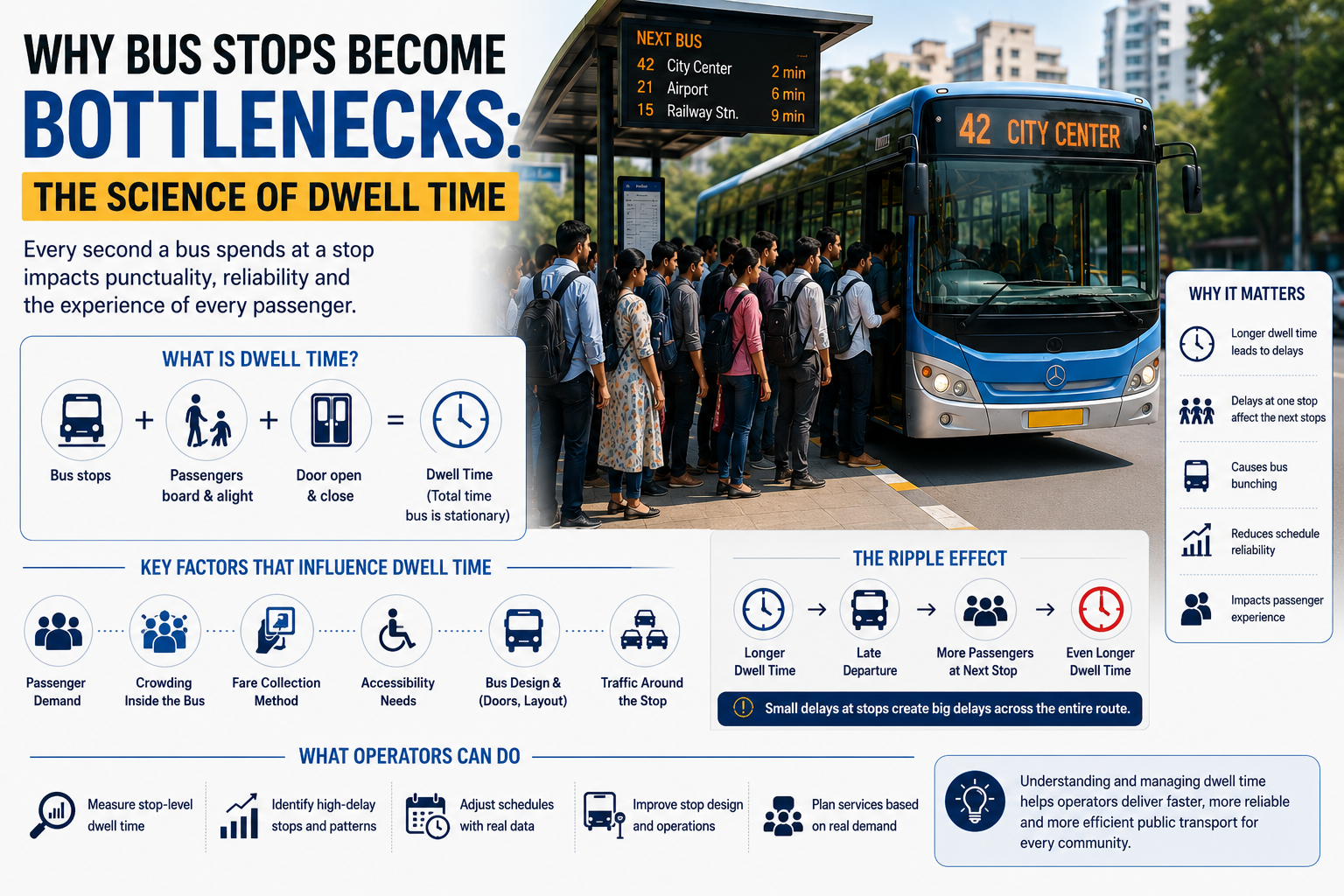
It is the time the bus spends standing at its stops. This is known as bus dwell time—the period a bus remains stopped to allow passengers to board and alight, including the time required to open and close the doors. It sounds like a small part of a journey.
It isn't.
Research has shown that dwell time can make up a significant portion of urban bus travel time, and variations in dwell time are an important contributor to unreliable bus operations. The interesting part is that dwell time is not fixed.
It changes with passenger demand, crowding, vehicle design, fare collection, accessibility requirements, stop design and several other factors. That is why a bus stop can quietly become a bottleneck for an entire route.
What Actually Happens When a Bus Stops?
Consider a busy morning bus. The vehicle reaches a stop with 20 people waiting outside. At the same time, 10 passengers want to get off. The doors open. Passengers move in different directions.
People get off. Others try to board. Someone is standing near the doorway. Another passenger is carrying a large bag. A passenger using a wheelchair or mobility aid may need additional assistance. Only when the passenger movement is complete can the doors close and the bus leave.
The bus may have spent only a minute or two at the stop. But multiply that across 30 or 40 stops, and those minutes begin to matter.
Research has consistently found that the number of boarding and alighting passengers is one of the strongest factors influencing dwell time. Other factors include vehicle characteristics, fare systems, passenger crowding and accessibility-related activities.
The Science Behind Dwell Time
At its simplest, dwell time can be thought of as having a basic fixed component plus the time required for passenger movement. The fixed component includes things such as stopping and opening and closing the doors.
The variable component comes largely from passenger activity. More passengers generally mean more movement. More movement means more time. But the relationship isn't perfectly linear.
When a bus becomes crowded, passengers already inside the vehicle can interfere with passengers trying to board or alight. Researchers describe this as passenger friction or crowding effects. The movement of people through a crowded doorway becomes less efficient, increasing the time required to serve the stop.
So the situation can develop like this:
More passengers → more boarding and alighting → longer dwell time → slower journey.
And that's only the beginning.
When a Busy Stop Starts Affecting the Next Stop
Imagine a bus is scheduled to reach a major interchange at 8:30 AM. It arrives at 8:30, but heavy passenger activity keeps it there for another three minutes.
It leaves late. At the next stop, passengers have already been waiting longer than expected. More people board.
The bus spends even longer at that stop. Now the original three-minute delay has become five or six minutes. This is one reason dwell-time variability matters so much.
The problem isn't simply that the bus stopped for a little longer. The extra time can influence what happens at the stops that follow. Research has linked variability in boarding and alighting time with service unreliability and bus bunching.
Why Crowded Buses Can Become Slower
There is a less obvious relationship between crowding and speed. A crowded bus doesn't necessarily travel slowly because its engine is working differently.
It can become slower because passengers take longer to move through the vehicle.
When more people are standing near the doors, boarding and alighting passengers have less space to move. That creates friction. The more difficult it becomes for people to move, the longer the bus remains at the stop.
Research using empirical passenger data has found that boarding and alighting times increase with the number of passengers boarding, the number alighting, and the number already on board.
This creates an important operational relationship:
Crowding isn't only a passenger-comfort problem. It can become a service-reliability problem.
Bus Design Makes a Difference Too
Not every bus handle passenger movement in the same way. The number and width of doors matter. Floor height matters. Interior layout matters.
The location of seats and standing areas matters. The fare collection system matters. A bus designed to move passengers quickly through multiple doors can behave very differently from a vehicle where most passengers must use one doorway.
Research has examined how vehicle configuration, number of doors, floor design and fare collection affect passenger movement and dwell time.
This is why simply looking at the number of buses operating on a route does not tell the whole story. Two routes can have the same number of vehicles but deliver very different levels of service.
The Bus Stop Itself Can Become Part of the Problem
The design and location of a stop also matter. A bus bay, curbside stop, narrow platform, passenger shelter or surrounding road layout can influence how efficiently a bus can serve passengers and re-enter traffic.
Research comparing bus stop designs has found differences in operating performance between curbside stops and bus bays, including differences in passenger service and acceleration time.
This becomes especially important on busy urban corridors. A bus may finish boarding quickly but then struggle to merge back into traffic.
So the actual delay associated with a stop can involve more than the time spent with the doors open.
Accessibility Is Part of Good Operations
There is another factor that should never be treated simply as "extra delay."
Public transport needs to work for everyone. Passengers using wheelchairs, walkers, scooters or other mobility aids may require ramps or lifts and additional boarding time. Passengers carrying bicycles, strollers or large items can also affect movement through the doorway.
Research has found that mobility aids and passenger encumbrances can contribute to variability in bus dwell time. The answer isn't to reduce accessibility. It is to plan for it properly.
A reliable timetable should reflect the real conditions under which the service operates.
Why Average Dwell Time Isn't Enough
Suppose an operator calculates that the average dwell time across a route is 45 seconds. That number might be useful. But it can also hide the real problem. One stop may average 20 seconds.
Another may average 90 seconds. A third might normally take 30 seconds but take three minutes during the morning peak. The route-level average doesn't tell the operator where the problem originates.
This is why stop-level analysis is so valuable. Modern AVL and automatic passenger-counting systems can provide detailed information about vehicle movements and passenger activity.
Research has shown that archived AVL/APC data can be used to study the factors affecting dwell time at individual stops and across routes.
Dwell Time Can Also Tell You Something About Demand
There is an interesting reverse relationship here. Dwell time isn't only something operators need to manage. It can also provide clues about what is happening with passenger demand.
Researchers have explored whether boarding and alighting flows, passenger loads and even origin-destination information can be estimated using dwell-time observations.
That means a stop where dwell time suddenly increases may be telling the operator something. Perhaps passenger demand has changed. Perhaps a new office, college, residential development or transport interchange has altered travel patterns.
Perhaps the route simply needs more capacity during a particular period. The bus stop is no longer just a place where passengers wait. It becomes a source of operational intelligence.
What Transport Operators Can Monitor
A useful dwell-time analysis should look beyond a single number.
Operators can examine:
- Average dwell time by stop
- Boarding and alighting volumes
- Peak vs. off-peak dwell time
- Dwell-time variability
- Passenger load
- Door usage
- Schedule deviation
- Stop-level delays
- Route-level delay accumulation
- Recurring high-delay locations
The goal is to identify patterns, not simply record delays.
If the same stop causes five minutes of additional delay every weekday morning, that is an operational problem worth investigating.
From Data to Better Decisions
This is where connected transport systems become useful.
If vehicle location, schedules, passenger activity and route performance are stored separately, identifying the cause of a delay can take time.
A connected platform can make it easier to compare what was planned with what actually happened.
For example:
Scheduled arrival → Actual arrival → Dwell time → Passenger activity → Departure delay → Impact on next stops
That gives an operator a much clearer picture of how a delay developed.
How RouteSync Can Help
RouteSync, developed by Arena Softwares, is designed to connect transport planning and operational information across the public transport lifecycle.
The platform brings together areas such as route planning, scheduling, vehicle monitoring, fleet operations and analytics, allowing transport teams to compare planned service with what is actually happening on the network.
For a dwell-time problem, this kind of connected visibility can help operators identify where delays are occurring, examine recurring patterns and understand how stop-level issues affect wider route performance.
The objective isn't simply to make buses spend fewer seconds at stops.
It is to understand why those seconds are being lost and whether the solution lies in scheduling, stop design, passenger flow, vehicle allocation, operational control or additional service capacity.
The Bigger Picture
A bus journey is made up of more than the time spent moving between stops. Every stop adds another small piece to the journey. Most of the time, those pieces are barely noticeable.
But on a crowded route, during a busy period, a few extra seconds repeated over and over can become a serious operational problem.
That is what makes dwell time so important.
It sits at the intersection of passenger demand, vehicle design, accessibility, stop infrastructure, scheduling and service reliability.
And perhaps the most useful lesson is this:
When a bus is running late, don't only ask how fast it was travelling. Ask where it was standing—and why.
Sometimes the biggest delay on a route isn't happening between the stops. It is happening at them.
147
 Facebook
 Instagram
 LinkedIn
 YouTube