
Cart is empty
The Mohring Effect: Why More People Using Public Transport Can Actually Make It Better
10/08/2026
Public transport has an interesting problem.
When more people start using buses, trains, or metro services, the system can become more crowded and expensive to operate. But there is another possibility: higher demand can also encourage better service.
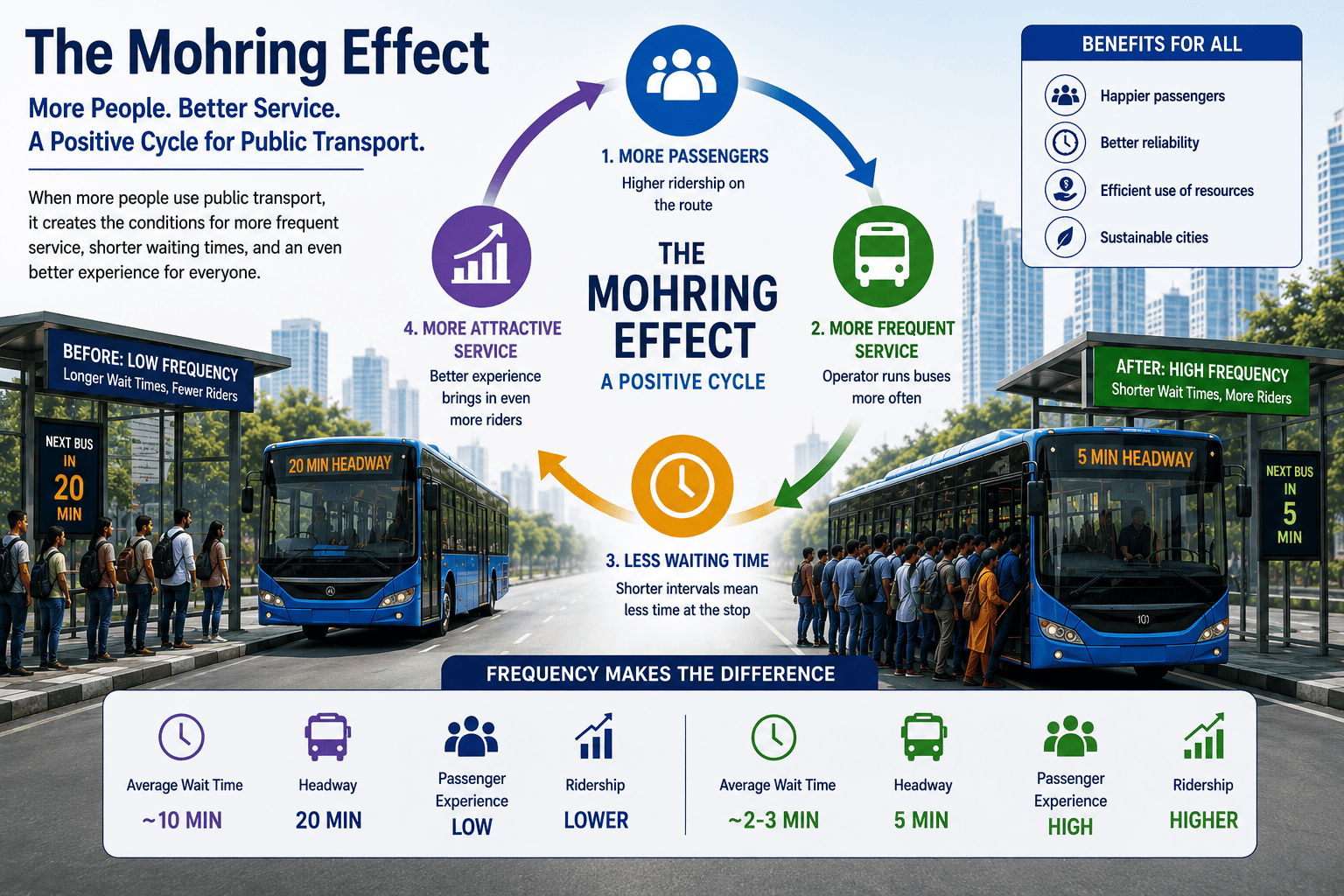
More passengers can justify more frequent services. More frequent services mean shorter waiting times.
Shorter waiting times can make public transport more attractive to even more people.
This feedback loop is known in transport economics as the Mohring Effect. It was developed from the work of economist Herbert Mohring in the 1970s and has since become an important concept in understanding public transport frequency, waiting time, demand, and subsidies.
The basic idea is surprisingly simple:
More demand → higher service frequency → less waiting → more attractive public transport → potentially more demand.
But there is much more happening underneath this simple cycle.
What Exactly Is the Mohring Effect?
Imagine a bus route where a bus arrives every 20 minutes. If a passenger arrives randomly at the bus stop, the average waiting time is roughly half the headway—about 10 minutes, assuming the service is regular.
Now imagine the operator increases the frequency to every 10 minutes. The average waiting time falls to roughly 5 minutes.
Nothing about the passenger's journey on the bus has changed. The route hasn't become shorter. The bus hasn't necessarily become faster.
The passenger simply spends less time waiting.
This matters because waiting is part of the real cost of using public transport. Transport research has long considered waiting time, access time, in-vehicle time, comfort, and other factors when evaluating the passenger's overall cost of a journey.
Where Does the "More Passengers" Part Come From?
This is where the effect becomes interesting.
Suppose a bus route starts attracting more passengers. The operator sees stronger demand and has a reason to increase service frequency. More buses are placed on the route, reducing the gap between departures.
Passengers now spend less time waiting.
For someone deciding between taking the bus or using a private vehicle, that shorter and more predictable wait can make public transport more appealing.
The additional passenger doesn't just benefit from the existing service.
Their demand can contribute to the case for providing a higher level of service that also benefits other passengers.
This is the positive externality at the centre of the Mohring Effect. Research on the subject describes it as the reduction in average waiting time that can occur when higher demand leads to higher service frequency.
Frequency Is More Important Than It Looks
Passengers often think about public transport in terms of travel time. But frequency can be just as important.
A 30-minute journey with a bus every five minutes can feel very different from a 30-minute journey with a bus every 30 minutes.
With frequent service, passengers don't necessarily need to plan their arrival around a timetable. They can reach the stop and expect another bus relatively soon.
This changes the way people experience the network.
Frequency therefore affects more than the number of buses operating. It influences the waiting cost of the entire passenger population.
That is one reason frequency is such an important variable in public transport planning. Classical Mohring models link higher demand with higher optimal frequency and lower waiting times.
A Simple Example
Consider a city route carrying 6,000 passenger trips per day.
The operator currently runs buses every 15 minutes during the busiest period.
Demand continues to increase.
Instead of allowing waiting times and crowding to increase indefinitely, the operator adds vehicles and moves to a 10-minute headway.
Passengers now wait less.
The service becomes more attractive.
Some people who previously used cars, taxis, or other modes may consider the bus more practical.
The operator now has a route with higher demand and a better level of service.
This is the basic logic behind the Mohring Effect.
It doesn't mean that every increase in ridership automatically produces more buses. It means that when service supply responds appropriately to demand, higher patronage can create benefits for existing and new users through increased frequency.
Why This Matters for Public Transport Planning
This concept changes the way we think about public transport investment.
A bus is not useful only because it physically moves passengers from one location to another. Its frequency also affects the value of the service.
If an operator has limited resources, the question isn't simply:
"How many buses should we operate?"
It becomes:
"Where will additional frequency create the greatest improvement in passenger experience and network performance?"
That requires a much closer look at demand patterns.
- Peak-hour demand may justify additional frequency.
- An off-peak route may require a different service pattern.
- Two routes with similar passenger numbers may need different strategies because their demand is distributed differently throughout the day.
This is where transport planning becomes a data problem rather than a simple vehicle-counting exercise.
The Mohring Effect Has a Limit
There is an important part of the theory that shouldn't be overlooked. More passengers do not always make public transport better.
If demand becomes too high and service capacity doesn't increase accordingly, the system can move in the opposite direction.
- Buses become crowded.
- Boarding and alighting take longer.
- Dwell times increase.
- Vehicles can become delayed.
- Passengers may have difficulty boarding.
- At extreme levels, additional demand can actually reduce service quality.
Recent research has shown that congestion and crowding can weaken or even reverse the traditional economies associated with the Mohring Effect. In heavily congested systems, increasing demand can create diseconomies rather than continually improving the service.
So, the real lesson isn't simply "more passengers are better."
It is:
More passengers can create the conditions for better service—but only when capacity and operations can respond to that demand.
Why Data Becomes Important
This is where modern public transport operations become particularly interesting.
An operator needs to know much more than the number of passengers using a route.
It needs to understand:
- When demand increases
- Where passengers board and alight
- How long buses spend at stops
- How headways change during the day
- Where overcrowding begins
- How frequency affects ridership
- Whether additional buses actually improve service
Without this information, increasing frequency can become an expensive guess.
With good operational data, planners can identify where additional service is likely to create the greatest benefit.
From Economic Theory to Daily Operations
The Mohring Effect was developed as an economic concept, but its implications are very practical.
Transport operators deal with the same variables every day:
Demand. Frequency. Waiting time. Vehicle capacity. Operating cost.
Modern transport management systems can bring these variables together so planners don't have to evaluate them independently.
This is particularly important as cities expand their bus networks and try to encourage more people to use public transport.
How RouteSync Can Support This Planning
This is where an integrated platform such as RouteSync, developed by Arena Softwares, can help turn operational data into practical planning decisions.
RouteSync brings together fleet operations, scheduling, vehicle tracking, depot activities, passenger-related information, and operational analytics in one platform.
Instead of looking only at how many buses are available, transport authorities can build a broader picture of how vehicles, schedules, demand, and service performance interact.
That visibility can support decisions around frequency, fleet allocation, service monitoring, and operational adjustments—helping operators make better use of available resources as demand changes.
Final Thoughts
The Mohring Effect is more than an economic theory about buses.
It explains something passengers experience every day without necessarily knowing why.
When public transport becomes frequent and reliable, waiting becomes less important. When waiting becomes less important, the service becomes easier to use. And when more people find the service useful, there can be a stronger case for improving frequency again.
But the cycle only works when operators can match supply with demand.
Too little service creates long waits.
Too much demand without enough capacity creates crowding and delays.
The real opportunity lies somewhere between the two: using data to understand where additional service can create the greatest improvement for passengers and the network.
That is where transport economics, operational planning, and modern technology begin to meet.
44
 Facebook
 Instagram
 LinkedIn
 YouTube