
Cart is empty
Digital Twins in Traffic Management: How Cities Are Testing Mobility Changes Before Implementing Them
11/05/2026
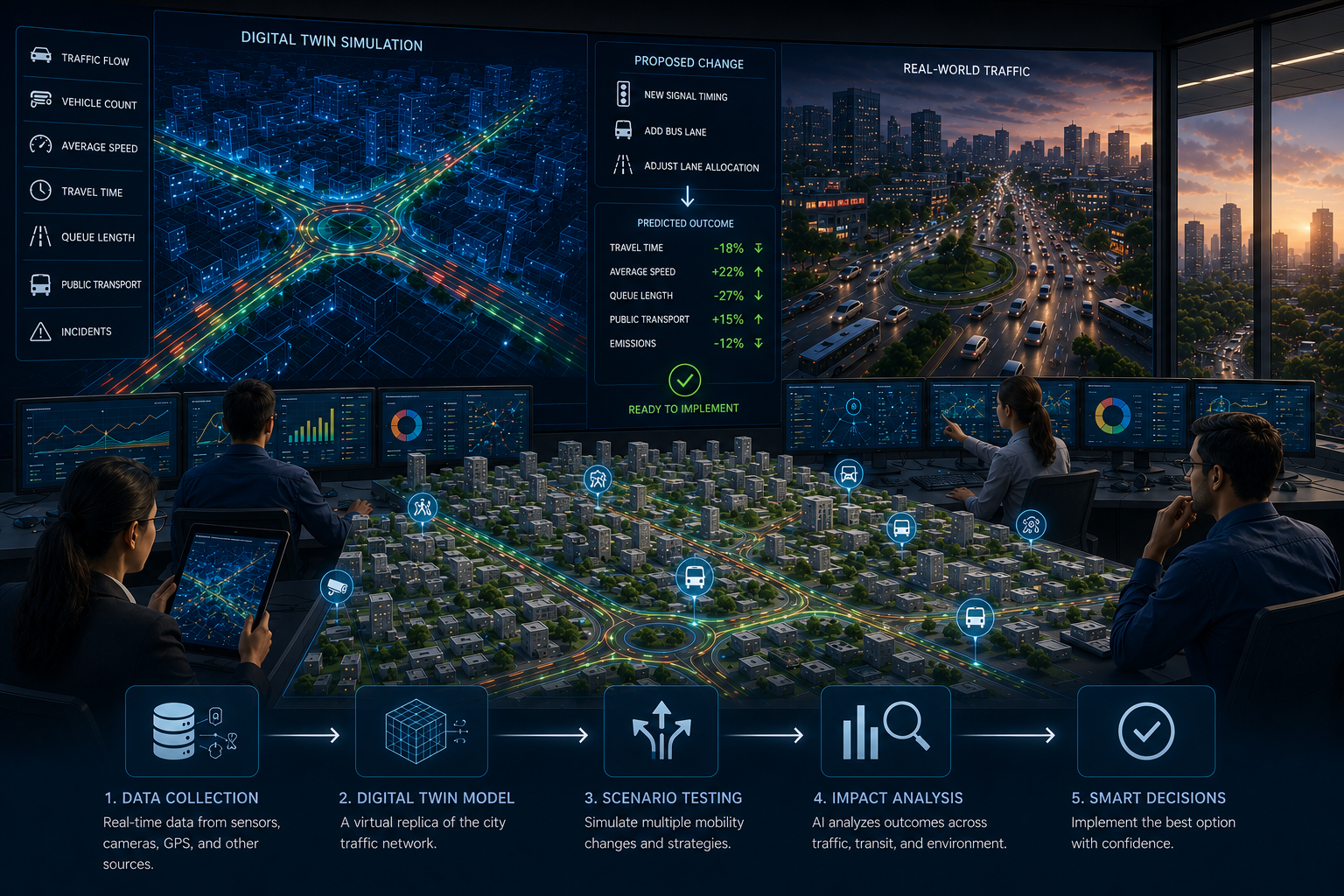
For decades, most traffic planning decisions in cities followed a familiar pattern.
A road would become congested, traffic studies would be conducted, changes would be proposed, and eventually the city would implement a solution in the real world. Sometimes it worked well. Other times, the results created new bottlenecks, unexpected delays, or public frustration.
The challenge was never a lack of effort. The real problem was uncertainty.
Traffic systems are incredibly dynamic. A small change at one junction can affect movement several kilometers away. Adjusting a signal cycle, redesigning a corridor, or rerouting buses may seem straightforward on paper, but once implemented, the outcomes are not always predictable.
This is exactly why the idea of digital twins in traffic management is attracting so much attention today.
Cities are beginning to realize that they no longer need to test major mobility decisions directly on the road first. Instead, they can simulate those changes digitally, observe how the network reacts, and make better-informed decisions before implementation.
And in many ways, this is changing how modern urban mobility planning works.
What a Digital Twin Actually Means in Traffic Management
The term “digital twin” can sound highly technical, but the concept itself is fairly practical.
A digital twin is essentially a virtual representation of a real traffic environment. It mirrors roads, intersections, traffic signals, vehicle movement, and sometimes even public transport operations in a digital model.
What makes it valuable is that the model behaves dynamically rather than statically.
Instead of simply showing traffic conditions, the system can simulate how the network reacts under different scenarios. Cities can test changes digitally and observe potential outcomes before making adjustments in the real world.
This allows planners to move from assumption-based planning toward simulation-based decision-making.
Why Cities Struggle with Real-World Traffic Experiments
One of the biggest difficulties in urban traffic planning is that real-world experimentation carries risk.
A poorly timed signal adjustment can create congestion across an entire corridor. A route diversion may affect nearby intersections more than expected. Even temporary road closures can trigger ripple effects that spread far beyond the original location.
And once these changes are implemented physically, reversing them is rarely immediate or simple.
Cities also face another challenge—public response.
Residents and commuters often react strongly to traffic changes, especially when disruptions appear quickly. That creates pressure on authorities to make decisions carefully and avoid trial-and-error implementation wherever possible.
This is where simulation becomes extremely useful.
Instead of testing changes directly on live traffic, authorities can first evaluate them within a digital environment.
How Digital Twins Help Simulate Urban Mobility
The real strength of digital twins lies in their ability to model different mobility scenarios before implementation.
For example, a city may want to understand:
- how a new flyover could affect nearby intersections
- whether changing signal timing improves traffic flow
- how bus rerouting impacts surrounding roads
- what happens during large public events or diversions
Rather than relying only on static traffic studies, planners can simulate these conditions and observe how traffic patterns shift over time.
This becomes especially valuable in fast-growing cities where road networks are under constant pressure and even small inefficiencies can escalate quickly.
Where AI and Real-Time Traffic Data Come Together
Digital twins become far more powerful when combined with AI and live operational data.
Traffic systems today generate enormous amounts of information through the following:
- cameras and sensors
- GPS-enabled public transport fleets
- traffic signal systems
- passenger and mobility data platforms
AI helps process these inputs continuously, identifying movement patterns and predicting how traffic conditions may evolve under different circumstances.
When integrated with platforms like RouteSync from Arena Softwares, digital traffic models can also include public transport movement and operational behavior.
This creates a broader view of urban mobility where traffic management and transit planning are no longer treated separately.
Instead of looking only at vehicle congestion, cities can evaluate how road conditions affect buses, schedules, passenger movement, and corridor reliability together.
Why This Matters for Public Transport Operations
Public transport systems are often heavily affected by traffic conditions, particularly in dense urban corridors.
A small increase in congestion at key intersections can quietly affect the following:
- bus punctuality
- trip completion rates
- headway consistency
- passenger waiting times
With digital twins, cities can test how traffic adjustments influence public transport before changes are implemented physically.
For example, planners may simulate the following:
- transit signal priority on busy corridors
- dedicated bus lane effectiveness
- rerouting during infrastructure work
- event-day transport planning
This allows transport authorities to evaluate operational impact in advance rather than reacting after implementation.
A Shift from Reactive Planning to Predictive Planning
Perhaps the biggest change digital twins introduce is a shift in mindset. Traditional traffic management has largely been reactive. Problems emerge first, and then authorities respond. Digital simulation encourages a more predictive approach.
Cities can begin asking:
- What happens if traffic volume increases by 20% on this corridor?
- How will a new commercial zone affect nearby intersections?
- Will this route redesign improve mobility or create new pressure points?
These are difficult questions to answer confidently through manual analysis alone.
Simulation allows cities to explore those scenarios before committing resources on the ground.
Challenges Cities Still Need to Address
Despite the advantages, implementing digital twin systems is not without challenges.
Cities often need to address:
- integration with legacy infrastructure
- data consistency across agencies
- scalability across large road networks
- coordination between traffic and public transport departments
There is also the question of long-term operational management. Digital twins are not static projects; they require continuous updates and reliable data inputs to remain useful over time.
Still, many cities are beginning to see this as a worthwhile investment because of the long-term operational clarity it provides.
Why Digital Twins Are Becoming Part of Smart City Planning
As urban mobility becomes more complex, cities are increasingly looking for ways to reduce uncertainty in planning.
Building more roads alone is rarely enough. Authorities need tools that help them understand how the entire mobility ecosystem behaves before making large-scale changes.
That is why digital twins are becoming an important part of modern Intelligent Traffic Management Systems (ITMS).
When combined with AI, operational platforms, and real-time mobility data, these systems allow cities to plan more confidently, respond more intelligently, and improve mobility outcomes with lower implementation risk.
Final Thought
Traffic systems are becoming too complex for cities to rely entirely on static studies and real-world experimentation.
Digital twins offer something urban planners have always wanted but rarely had—a way to test ideas safely before applying them in live environments.
And as AI, traffic analytics, and public transport systems become more connected, digital simulation is likely to play a much larger role in how cities plan mobility in the years ahead.
If your city is exploring how digital simulation, AI, and integrated traffic systems can support smarter mobility planning, you can request a demo from Arena Softwares to understand how platforms like RouteSync help support data-driven urban transport operations.
201
 Facebook
 Instagram
 LinkedIn
 YouTube