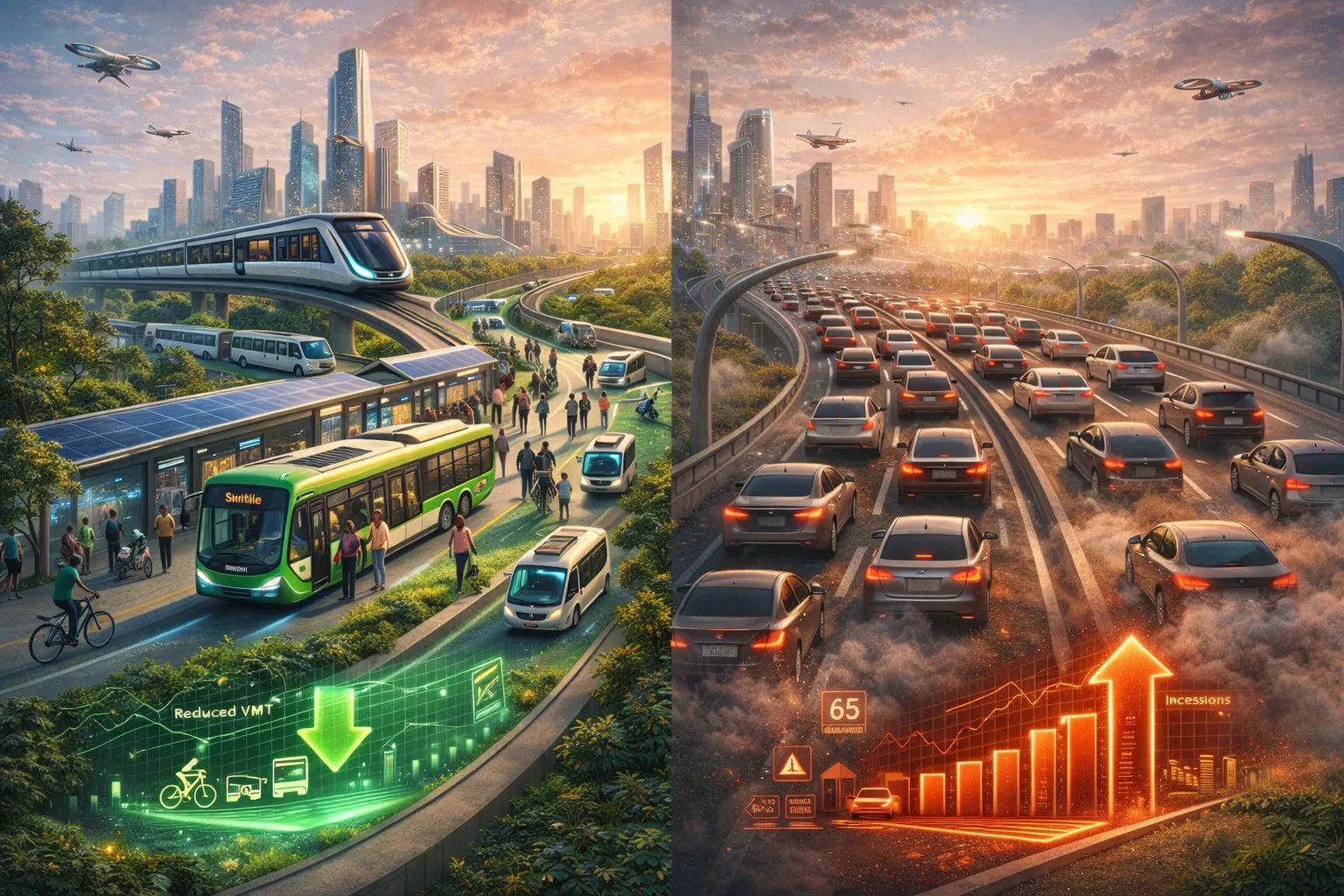
Whenever traffic congestion reaches a breaking point, the same solution comes up again and again: widen the road. Add another lane. Build a flyover. Push traffic faster through the same corridor.
And for a short while, it works.
Then traffic comes back—often worse than before.
This pattern has repeated itself in cities across the world, and by now the reason is well understood. Road expansion treats congestion as a space problem when in reality it’s a demand problem. As long as cities keep making it easier to drive, more people will choose to drive. The extra capacity fills up, and congestion returns.
What actually reduces traffic in a lasting way isn’t wider roads—it’s better public transport that people are willing to use.
Why Road Expansion Rarely Delivers Long-Term Relief
Wider roads do increase capacity, but they also change behaviour. When driving feels faster or easier, people who previously avoided peak hours start driving again. Others switch from public transport to private vehicles. Trips that were postponed suddenly happen.
Urban planners call this induced demand, and it explains why congestion almost always rebounds after road expansion.
At the same time, widening roads is expensive, disruptive, and space-hungry. In dense cities, it often comes at the cost of footpaths, trees, cycling lanes, or public space—making streets less liveable without actually solving the problem.
Congestion isn’t just about how much road you have. It’s about how many vehicles choose to use it.
The Real Leverage Point: Public Transport Accessibility
If congestion is a demand issue, then the most effective solution is to reduce the number of vehicles on the road—especially single-occupancy ones. That’s where public transport plays its most important role.
But this only works when public transport is genuinely accessible and reliable.
People don’t avoid buses or metros because they dislike the idea of public transport. They avoid it because:
- The first or last mile is inconvenient
- Feeder buses are unreliable or poorly timed
- Routes feel indirect or outdated
- Travel times are unpredictable
Fixing these issues has a far greater impact on congestion than adding another lane ever will.
Optimized Feeders: Where Mode Shift Really Begins
The decision to use public transport usually happens at the neighbourhood level, not at the metro station or bus terminal. If getting to the main route is difficult, people default to driving the whole way.
Well-planned feeder services change that equation.
Optimized feeders reduce walking distance, cut unnecessary detours, and align better with actual demand patterns. When feeders are reliable and well-timed, people are far more willing to leave their cars behind.
This is where mode shift actually happens—when daily commuters switch from private vehicles to buses, shuttles, or rail because the system feels easier, not harder.
Arena Softwares addresses this directly through RouteSync, which helps cities redesign feeder routes based on real demand, not legacy assumptions. By clustering passengers intelligently and reducing wasted kilometres, feeders become both more efficient and more attractive to users.
Rationalized Bus Routes Reduce Vehicle Miles Travelled (VMT)
Another hidden contributor to congestion is inefficient public transport itself. Poorly planned bus routes can result in:
- long, overlapping corridors
- buses running half-empty
- excessive route length with low productivity
This increases Vehicle Miles Travelled (VMT) without delivering proportional mobility benefits.
Rationalizing bus routes—shortening them, removing redundancies, and aligning them with real demand—reduces unnecessary bus movement while improving service quality where it’s actually needed.
When done well, this creates a double benefit:
- fewer buses running empty or inefficient routes
- more passengers carried per kilometre
Lower VMT means less congestion, lower emissions, and better use of road space.
RouteSync supports this process by analysing route performance, passenger density, and travel patterns, helping transport agencies move away from “we’ve always run this route” thinking toward evidence-based planning.
Why Public Transport Scales Better Than Roads
Roads don’t scale well in cities. Every new lane encourages more cars. Public transport, on the other hand, scales efficiently. One full bus can replace dozens of private vehicles. One well-used feeder route can remove hundreds of short car trips every day.
When public transport becomes the easier choice—not just the cheaper one—cities start to see real congestion relief. Travel speeds stabilize. Peak pressure eases. Streets become more predictable.
This is why cities that invest in accessibility and service quality, rather than just infrastructure expansion, see better long-term outcomes.
The Arena Softwares Perspective
At Arena Softwares, the focus is not on adding more vehicles or more roads, but on making existing transport systems work better together.
With RouteSync, cities can:
- optimize feeder routes to improve first- and last-mile access
- Rationalize bus networks to reduce unnecessary VMT
- support mode shift by making public transport more convenient
- improve reliability without major infrastructure expansion
The goal is simple: fewer vehicles on the road, moving more people.
Conclusion
Traffic congestion isn’t solved by giving cars more space. It’s solved by giving people better alternatives.
Smarter public transport—supported by optimized feeders and rationalized routes—has a deeper, more sustainable impact on congestion than road widening ever can. It reduces Vehicle Miles Travelled, encourages mode shift, and makes cities move more efficiently without endless construction.
With platforms like RouteSync, Arena Softwares helps cities take this smarter path—one where congestion is addressed at its source, not just pushed further down the road.
The future of congestion relief isn’t wider roads. It’s better public transport that people actually choose to use.

Comments
0 messagesLeave a comment
Your email won't be published. Anonymous commenters can skip both name and email.