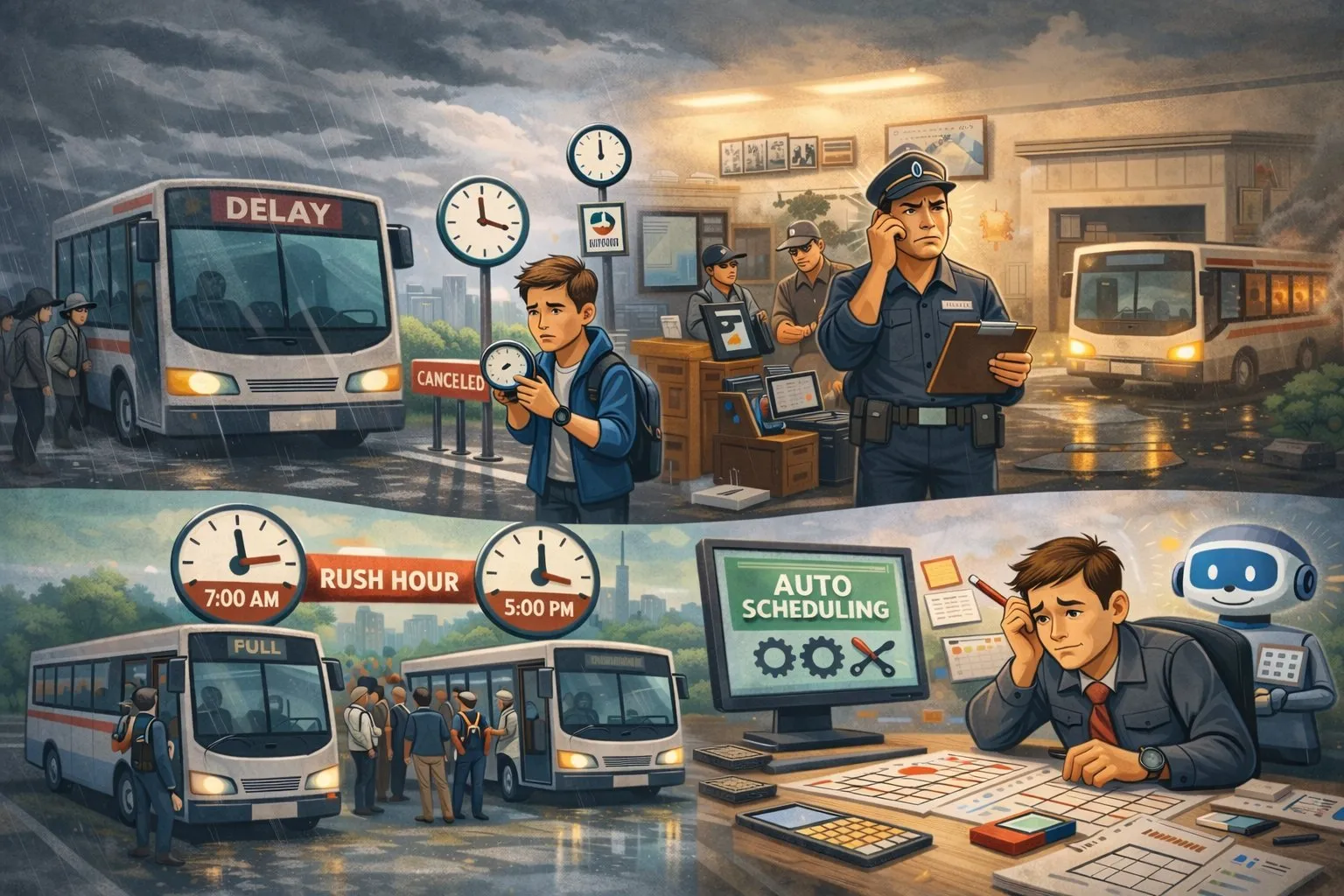
In most transport organisations, timetables get a lot of attention. They’re reviewed, approved, published, and often treated as the backbone of the operation. Once that’s done, the expectation is simple: services should run as planned.
But anyone involved in daily operations knows that this rarely happens.
The problem isn’t that timetables are poorly designed. The problem is that timetables are often mistaken for schedules. They aren’t the same thing. A timetable describes intent. Trip scheduling decides whether that intent can survive real operating conditions.
When the two are blurred together, operators end up firefighting every day — not because staff are careless, but because the system was never set up to cope with reality.
Why Timetables Break Down Once the Day Starts
Timetables are usually built using assumed travel times, expected dwell durations, and clean turnarounds. On paper, that’s unavoidable. But on the road, conditions shift constantly.
Traffic doesn’t behave the same way every hour. Boarding patterns change depending on schools, offices, weather, or events. Even a small delay early in the day can ripple through later trips if there’s no breathing room built in.
What’s often missed is that many timetables aren’t stress-tested against operational constraints. Depot exit capacity, realistic turnaround time, vehicle availability windows — these tend to be secondary considerations. So the timetable looks reasonable, but the first few trips already start under pressure.
Once that happens, the rest of the day is about recovery, not delivery.
Where Trip Scheduling Makes or Breaks the Day
Trip scheduling is where the gaps start to show.
This is the stage where vehicles, drivers, depots, and maintenance realities collide with the timetable. And this is also where many operators rely heavily on manual adjustments and local knowledge to “make it work”.
Common issues show up quickly:
- vehicles assigned trips they can’t physically reach on time
- drivers scheduled back-to-back without enough buffer
- depots dealing with last-minute swaps
- maintenance holding vehicles that were assumed available
None of these appear in the timetable. But all of them affect whether the first trip leaves on time — and whether the rest of the service stays stable.
Good trip scheduling doesn’t aim for perfection. It aims for deliverability. It accepts that variability exists and builds enough structure around it to stop small issues becoming daily failures.
Peak Hours: Where Weak Scheduling Is Exposed Fast
If a schedule is fragile, peak hours will expose it.
A common response to peak demand is simply to add more trips. But if the underlying schedule doesn’t allow enough turnaround, recovery, or dispatch capacity, increasing frequency often makes things worse.
Drivers feel the pressure first. Depots feel it next. Then passengers experience missed trips, bunching, and inconsistent gaps.
Strong peak scheduling is less about pushing maximum output and more about controlling risk. Slightly longer recovery at terminals, clearer crew boundaries, and staggered dispatch often lead to better peak performance than aggressive timetables that collapse under pressure.
It’s one of those counter-intuitive lessons operators learn the hard way.
Manual vs Automated Scheduling: Where the Balance Shifts
Manual scheduling relies heavily on experience, and that experience matters. But as networks grow, the number of variables becomes difficult to manage consistently.
Fleet mix, crew rules, depot capacity, maintenance windows, recovery time — trying to balance all of this manually usually leads to compromises that are hard to track or repeat.
Automation doesn’t replace judgement. What it does is remove blind spots. It allows planners to test feasibility, see conflicts early, and understand the downstream impact of changes before they show up in operations.
Tools like ScheduleSmart from Arena Softwares support this shift by helping operators move from “we think this will work” to “we know this can be delivered”.
Why This Distinction Matters More Now
In today’s operating environment, transport agencies don’t have much tolerance for instability. Missed trips, late starts, and crew fatigue are no longer seen as unavoidable—they’re seen as signs that something upstream isn’t working.
Separating timetable generation from trip scheduling helps address that upstream problem. It forces organisations to look beyond what looks good on paper and focus on what can actually run, day after day.
When that happens, depots become calmer, crews become more predictable, and service reliability improves without adding more resources.
Closure
Timetables describe what a service should look like. Schedules decide whether it actually works. When operators rely on timetables alone, daily instability is almost guaranteed. Focusing on realistic trip scheduling — grounded in crew limits, depot capacity, and fleet readiness — is what turns planning into performance. ScheduleSmart, powered by Arena Softwares, is built around this reality, helping operators convert planned timetables into schedules that can be executed consistently on the ground.
Request a ScheduleSmart workflow walkthrough to see how practical, constraint-aware scheduling can improve peak performance and reduce daily operational stress.



Comments
0 messagesLeave a comment
Your email won't be published. Anonymous commenters can skip both name and email.