
Cart is empty
The Role of AI & Video Analytics in Intelligent Traffic Management Systems
12/12/2025
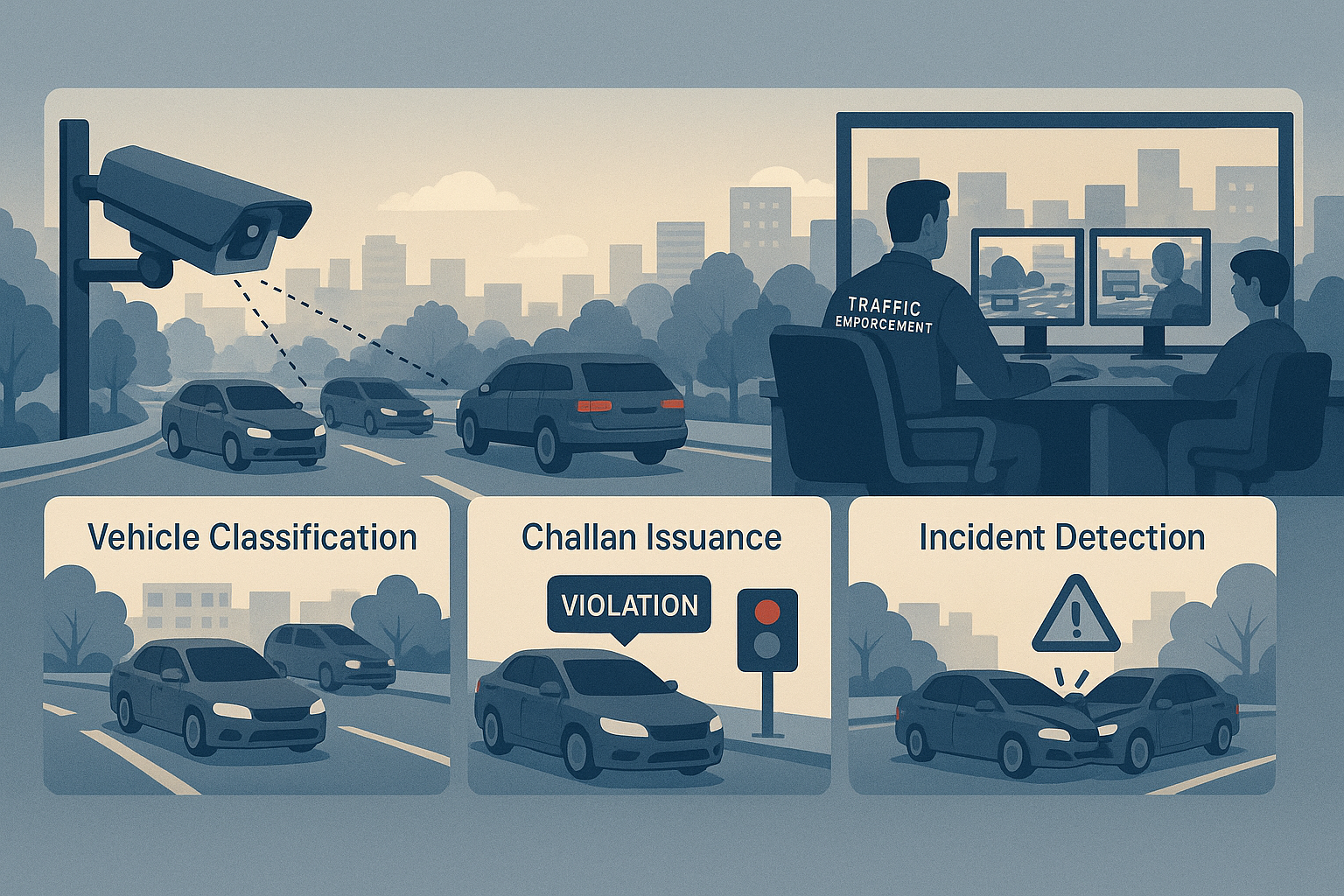
If you sit inside a traffic control room for even a few hours, you realise how quickly things can go wrong. One stalled car, one signal jump, one blocked lane — and suddenly an entire stretch of road is crawling. Not because the city doesn’t have infrastructure, but because no one noticed the problem early enough.
For years, cities tried to solve this with cameras. Install more CCTV, add more screens, and put more people in front of them. And for a while, that helped. But cameras alone don’t manage traffic — they just record it. Someone still has to watch, interpret, and react. And humans can only do so much, especially across hundreds of junctions.
That’s where AI-driven video analytics started to matter—not as a buzzword, but as a practical necessity.
When cameras stop being “eyes” and start being “signals”
The real shift happened when video feeds stopped being passive. Instead of just showing what’s happening, systems began to understand what they were seeing.
- A vehicle crossing a stop line isn’t just movement — it’s a violation.
- A sudden drop in average speed isn’t just traffic — it’s congestion building up.
- A stationary object in the middle of a lane isn’t background noise — it’s a problem waiting to spread.
AI analytics catches these patterns instantly, without waiting for someone to notice. That alone changes how traffic teams operate. They stop reacting late and start responding early.
Enforcement becomes consistent — not aggressive.
One thing traffic departments struggle with is consistency. Officers can’t be everywhere, and manual enforcement always leaves room for debate. Someone missed a signal violation, someone else got penalised — and suddenly, enforcement feels uneven.
With AI-based video analytics, that changes. Violations are detected the same way every time. Red-light jumps, wrong-side movement, and lane misuse — the system flags them the moment they happen and captures clear evidence.
Challan issuance becomes quieter, cleaner, and frankly less emotional. It’s no longer about who was watching at that moment. The system saw it, recorded it, and logged it. That alone reduces disputes and builds public trust over time.
Why vehicle classification quietly matters a lot
This part often gets overlooked, but it’s important.
Traffic isn’t just “traffic. A two-wheeler behaves very differently from a truck. A bus affects flow differently from a car. When systems start recognising vehicle types automatically, patterns begin to emerge that humans usually miss.
You start seeing which corridors are freight-heavy.
Where buses get stuck repeatedly.
Which junctions struggle because of mixed vehicle behaviour?
That information doesn’t just help day-to-day operations—it helps planners make better long-term decisions.
Congestion doesn’t explode — it grows.
Anyone who’s managed urban traffic knows this: congestion doesn’t suddenly appear. It builds. Slowly at first. A few vehicles hesitate, speeds drop, queues lengthen, and then suddenly the junction is blocked.
AI video analytics spots this early. It notices density changes and speed drops long before things get out of hand. Alerts go out while there’s still time to act — tweak a signal, divert traffic, or move a stalled vehicle. From a commuter’s perspective, it just feels like “traffic wasn’t as bad today”. They don’t see the intervention, but they feel the result.
Incidents are where response time really counts.
Accidents, breakdowns, pedestrians in restricted zones — these aren’t rare events. What matters is how fast they’re detected. In older setups, control rooms often waited for a phone call or an officer’s report. By then, traffic had already backed up. With AI-driven incident detection, alerts come in immediately, with visuals. Response teams move faster. Secondary congestion is avoided. Sometimes, that early response is the difference between a minor disruption and a full-scale jam.
Where Arena Softwares and RouteSync fit naturally
All this intelligence is useful only if it leads somewhere. Data without coordination doesn’t solve much.
This is where Arena Softwares, through platforms like RouteSync, plays an important role. RouteSync doesn’t treat traffic monitoring, enforcement, and routing as separate problems. It connects them.
- If video analytics flags congestion, RouteSync can help redirect movement.
- If an incident is detected, nearby routes and signals can adapt.
- If vehicle data shows repeated bottlenecks, planners have something concrete to work with.
Instead of dozens of disconnected systems, command centers get one operational picture.
And importantly, people remain in control. RouteSync doesn’t replace judgment — it supports it. It filters what matters, reduces noise, and helps teams act with confidence instead of pressure.
Control rooms don’t need more screens—they need clarity
Modern city command centers are already overloaded. More cameras don’t help if no one knows where to look. AI analytics and RouteSync change that dynamic. Operators aren’t scanning endlessly. They’re responding to prioritised alerts with context. Less fatigue, better decisions, faster action.
That’s a very human benefit, often ignored in tech discussions.
This isn’t the future—it’s basic infrastructure now.
AI video analytics isn’t experimental anymore. Cities using it aren’t “trying something new”; they’re catching up to reality. Traffic volumes are rising. Expectations are rising. Manual systems can’t scale. When AI-driven video feeds are integrated with platforms like RouteSync from Arena Softwares, traffic management stops being reactive and starts being intentional.
Not perfect. Not automated beyond control. Just smarter.
Final thought
Better traffic management doesn’t come from watching more footage or issuing more penalties. It comes from understanding what’s happening on the road as it happens — and responding before small problems grow.
That’s the quiet value of AI video analytics. And that’s where Arena Softwares, through RouteSync, fits in — helping cities move from observation to action, without losing the human element.
212
 Facebook
 Instagram
 LinkedIn
 YouTube