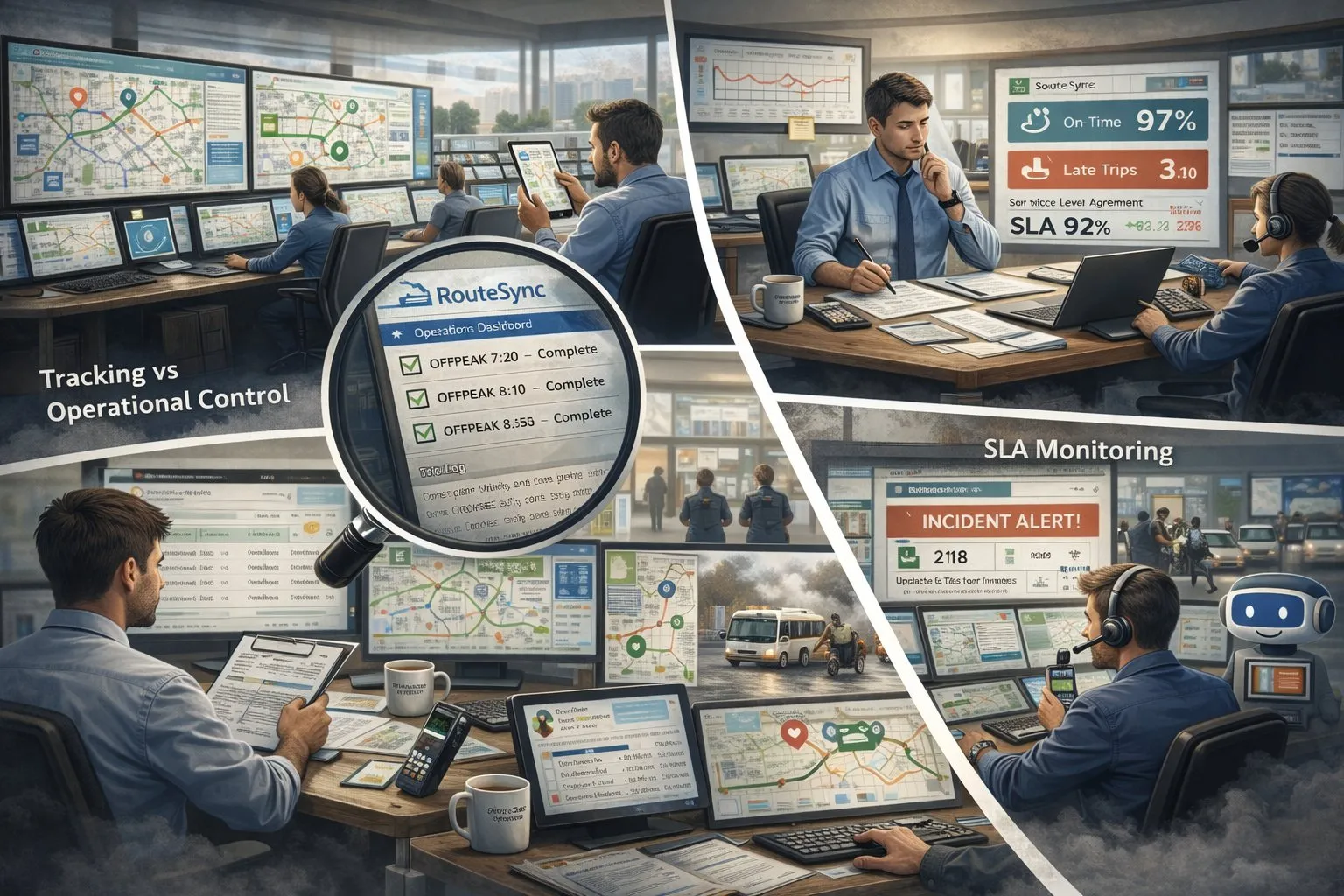
When agencies say they have real-time tracking, what they usually mean is this: there’s a screen somewhere with buses moving across a map.
That’s useful. It gives visibility. But if we’re honest, visibility alone doesn’t fix much. Seeing that a bus is late doesn’t automatically improve the service. Watching a vehicle icon slow down in traffic doesn’t tell you what to do next. And knowing where a bus is located doesn’t confirm whether the trip was actually delivered as planned.
Real-time tracking becomes valuable only when it helps operations teams make better decisions in the moment. That’s where the real difference lies — not in the map, but in what the system allows you to act on.
Tracking vs Operational Control
There’s a quiet but important distinction between monitoring and controlling.
Monitoring is passive. It answers: Where is the bus right now? Operational control answers: What should we do about it?
In many control rooms, staff can see delays happening, but they still rely on manual interpretation to decide whether to intervene. Is the delay small enough to recover? Will it affect the next trip? Is headway collapsing behind it? Will this create a missed departure later?
Without context, tracking data is just noise. When real-time tracking is connected to schedules, headways, crew duties, and depot dispatch logic, it becomes something more useful. It starts flagging risks before they escalate. It shows not just location, but impact.
That’s the point where tracking stops being a display tool and becomes a management tool.
Trip Completion Is More Important Than Location
One of the biggest misconceptions in operations is assuming that if a bus appears on the map, the service has been delivered properly. But trips get shortened. Buses return early. Certain segments are skipped under pressure. Sometimes it’s justified. Sometimes it’s not. If the system doesn’t verify trip completion properly, those details only surface later — often during audits or performance reviews.
Real-time tracking becomes meaningful when it confirms whether a trip:
- covered the intended route
- served the required stops
- started and finished within expected tolerance
- complied with operational standards
That’s very different from simply showing movement.
When trip verification is built into the tracking system, agencies gain clarity. It reduces guesswork and strengthens accountability, especially in contracted operations.
RouteSync approaches tracking this way — not just as GPS monitoring, but as trip validation.
SLA Monitoring Shouldn’t Be Monthly
For many operators, service level agreements are reviewed at the end of the month. By then, whatever went wrong has already affected passengers.
Real-time tracking can change that entirely.
If on-time performance drops below threshold in a corridor, operations teams should know immediately. If trip completion rates dip in a zone, someone should see that same day. If adherence falls during peak hours, corrective action should happen while service is still running. When SLA metrics are visible in real time, performance becomes manageable rather than debatable.
This is where tracking proves its real worth — not as proof of what happened, but as protection against what might happen next.
Dispatch and Incident Response: Where Tracking Earns Its Value
The real test of tracking systems comes during disruption.
- A breakdown.
- Unexpected congestion.
- A vehicle stuck outside the depot.
- A missed departure at peak hour.
In those moments, a moving dot on a screen doesn’t help much. What matters is context.
- Which of the following trips will be affected?
- Is there a spare vehicle nearby?
- Should another bus be short-turned?
- Will this impact crew duty limits?
When tracking data is connected to scheduling and fleet availability, dispatch decisions become faster and calmer. Control rooms can respond with clarity instead of reacting under pressure.
This is the difference between watching problems unfold and actually managing them.
Why Cities Need More Than a Map
Most agencies already have some level of GPS tracking. The question is not whether buses are visible. The question is whether that visibility translates into better daily performance.
Real-time tracking becomes valuable when it:
- verifies service delivery
- supports dispatch decisions
- highlights risk early
- monitors SLA compliance continuously
- reduces reliance on end-of-day reconciliation
That’s when it starts influencing reliability, not just reporting it.
RouteSync, powered by Arena Softwares, is built around that idea — turning live vehicle data into operational insight instead of just screen visibility.
Closure
Showing a bus on a map is the starting point. It’s not the outcome.
The real value of real-time tracking lies in control—knowing which trips are at risk, which services need intervention, and where performance is slipping before passengers feel it. When tracking is integrated with scheduling, SLA benchmarks, and dispatch workflows, it stops being a visual tool and becomes an operational backbone.
If your tracking system is only showing location, you’re seeing part of the picture. The next step is turning that visibility into action. If you’d like to see how RouteSync combines tracking with trip verification, SLA monitoring, and dispatch-level control, request a tracking control center demo and explore how real-time visibility can evolve into real-time operational management.

Comments
0 messagesLeave a comment
Your email won't be published. Anonymous commenters can skip both name and email.