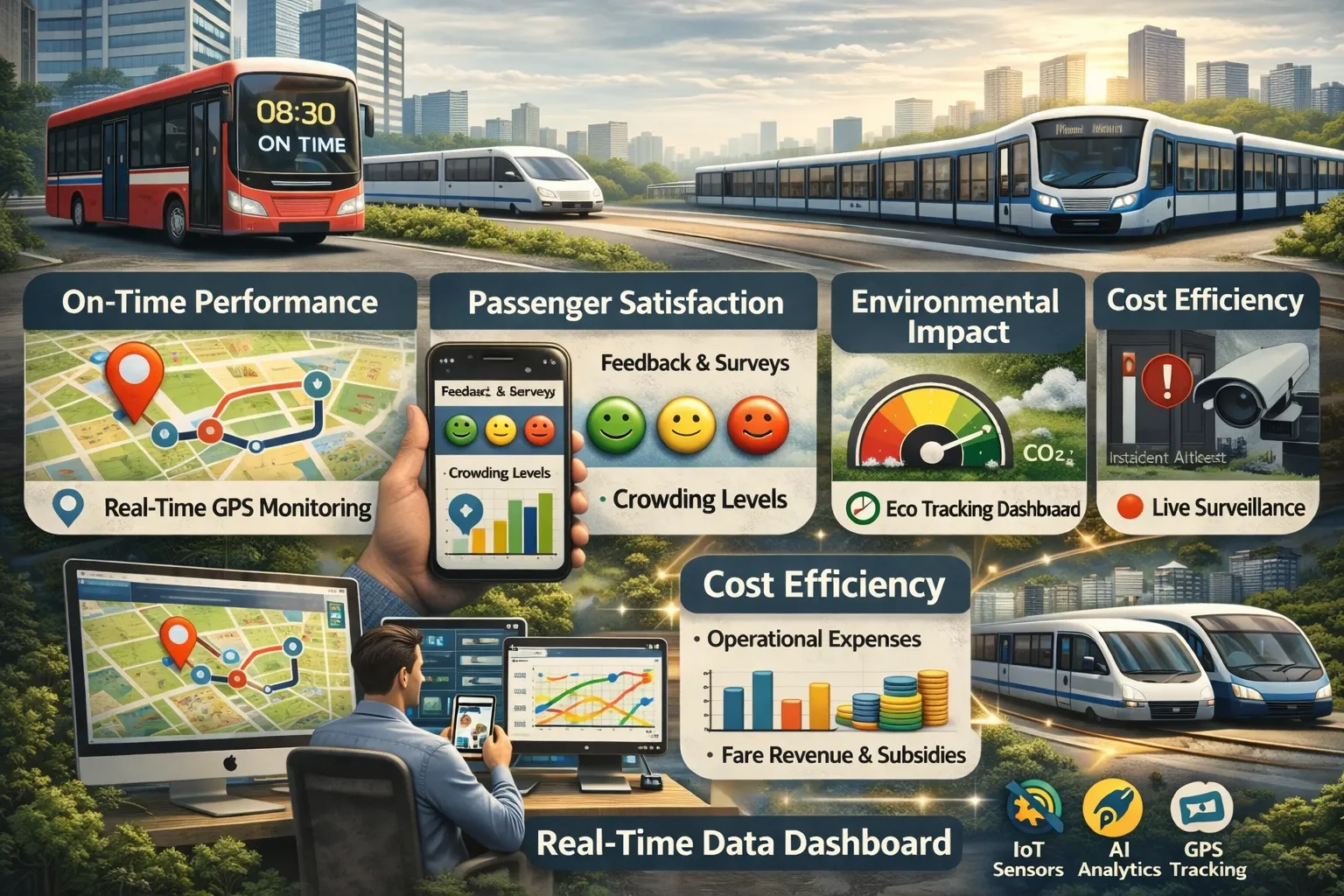
Public transport in 2026 is being measured on a very different yardstick than it was even a few years ago. Today, decision-makers are less interested in how many buses a city owns or how many routes it operates. What they want to know is whether the system performs consistently—whether services arrive reliably, capacity is managed intelligently, and passengers can trust the network every day.
That shift is exactly why KPIs have become so important. The right KPIs don’t just support reporting; they shape planning, budgeting, contract performance, and operational accountability. They help agencies move from “we believe service is improving” to “we can show you where, when, and how it is improving.”
However, the challenge is that many agencies still measure performance using outdated KPI structures—metrics that look acceptable in monthly reports but fail to capture what commuters experience daily. In 2026, that gap matters because public transport is competing directly with private mobility options, and passenger expectations are higher than ever.
Why Traditional KPIs Fail Public Transport
Traditional KPI systems usually fail not because the KPIs are meaningless, but because the way they are tracked makes them ineffective.
The first issue is time lag. Many KPI reviews still happen weekly or monthly. By the time data reaches management, operational failures have already played out on the ground—delays have compounded, missed trips have created crowding, and passenger trust has taken a hit.
The second issue is over-aggregation. Performance is often averaged across an entire network, which hides the very problems agencies need to solve. A city might report a “reasonable” on-time performance rate, while certain high-demand corridors regularly fail during peak hours. Similarly, a route might meet schedule targets on paper but still feel unreliable because buses arrive in clusters, creating long and unpredictable gaps.
The third issue is data fragmentation. GPS systems, ticketing systems, fleet maintenance records, and passenger feedback often sit in separate tools. When KPIs are generated from isolated systems, agencies may know what happened, but not why it happened. Was the route delayed because of congestion? Dispatch gaps? Long dwell times? Vehicle breakdowns? Without connected insight, the KPI becomes a statistic rather than a decision tool.
In 2026, KPI frameworks need to be operationally useful, not just audit-friendly.
The KPIs Modern Cities Measure in 2026
Most agencies in 2026 still track familiar KPIs, but the difference lies in how those KPIs are defined and used. Modern KPI frameworks focus on reliability, consistency, service delivery, capacity, and passenger experience—because those areas determine whether people choose public transport or avoid it.
· Reliability and Service Regularity
On-Time Performance (OTP) remains central, but it is increasingly measured at key stops, corridors, and interchange points rather than only at start or end points. That’s because passenger experience is shaped by what happens at the stops where people board and transfer—not what happens at the depot.
Headway adherence has also become a priority KPI, especially for high-frequency services. Passengers on a corridor running every 10–12 minutes do not experience service failure as “late buses.” They experience it as bunching: multiple buses arriving together and then long gaps afterward. Headway adherence captures that reality far better than timetable-based punctuality.
Trip completion rate is another KPI that agencies are measuring more seriously. It answers a simple but important question: how many trips that were scheduled were actually delivered end-to-end? Missed trips, early turnbacks, or short trips due to breakdowns or route deviations directly affect passenger trust, and trip completion makes those failures visible.
· Operational Efficiency and Fleet Utilization
Vehicle utilization measures how effectively the fleet is being deployed across routes and time windows. It helps agencies identify underused assets, imbalanced scheduling, and inefficient deployment patterns. In an environment where operational budgets are under constant pressure, this KPI is increasingly valuable.
Fuel or energy efficiency per trip is also being tracked more actively. Even for non-electric fleets, this KPI helps agencies understand where costs are bleeding—whether due to poor routing, excessive idling, traffic-driven inefficiency, or inconsistent driving patterns. It also connects strongly to sustainability goals.
· Capacity and Demand Management
Load factor (capacity utilization) has become one of the most critical KPIs because it reveals two expensive problems: overcrowding and underutilization. Overcrowding damages safety and passenger satisfaction. Underutilization wastes fuel, fleet time, and budget.
Many agencies now track crowding hotspots as a layer beyond load factor averages, identifying exact stops and time segments where passenger load frequently crosses thresholds. This supports practical interventions such as schedule adjustments, additional peak services, or better feeder planning.
· Passenger Experience and Network Stability
Passenger experience is increasingly treated as measurable performance. Complaints and feedback are now classified by category—delay, safety, cleanliness, comfort, staff behavior—and mapped to specific corridors or time windows. This turns feedback into something actionable rather than anecdotal.
Network stability also matters. Incident rate and service availability are now tracked more consistently, not only to improve operations but also to support compliance, SLAs, and service contracts. Stability KPIs help agencies understand whether service delivery is resilient under real-world conditions.
The key point is that these KPIs are not just “good to have.” They are the basis for operational decisions.
The Data Sources Needed to Track KPIs in Real Time
Real-time KPI measurement depends on one thing: connected data. Most cities already generate the raw data needed—but it is often disconnected.
GPS and AVL systems provide vehicle location, speed, and schedule adherence information. Ticketing and fare systems provide ridership patterns and boarding volumes. Passenger feedback systems provide service quality indicators that operational data cannot capture directly.
But to make this operationally reliable, agencies also need trip execution logs, which confirm whether trips actually started, whether they were completed, and where deviations occurred. Maintenance systems provide another critical layer by linking service disruptions to fleet health and breakdown patterns. Finally, ITMS traffic feeds help agencies understand whether delays are caused by traffic congestion or internal scheduling issues.
When these sources are integrated, KPI tracking becomes real-time, and performance management becomes proactive.
What Daily KPI Dashboards Look Like in Practice
The strongest agencies in 2026 don’t treat KPI tracking as a monthly ritual. They treat it as a daily operational discipline.
A well-designed KPI dashboard is not a wall of numbers. It is a decision tool. It makes it easy to see where performance is slipping today, what corridors require attention, which routes are consistently failing headway, and where passenger demand is exceeding planned capacity.
More importantly, it allows drill-down. Leadership needs high-level network performance summaries, but operations teams need corridor-level and stop-level visibility. The best dashboards allow both, without forcing teams to rely on separate tools.
This is where platforms like RouteSync, powered by Arena Softwares, become valuable. RouteSync supports real-time monitoring by bringing reliability, service delivery, demand patterns, and passenger experience into one unified performance view. For agencies, that means fewer reporting silos and more operational clarity.
Why Real-Time KPI Tracking Is Now a Strategic Advantage
Public transport is under pressure to deliver measurable improvements while keeping costs under control. Real-time KPI tracking has become one of the most effective ways to achieve both.
When performance is tracked continuously, issues are identified early. Service reliability improves because corrective action happens faster. Fleet utilization improves because resources are aligned with real demand. Passenger experience improves because the network becomes more predictable.
In practical terms, real-time KPI tracking shortens the gap between what passengers experience and what agencies can fix.
Conclusion
In 2026, public transport success is defined by performance consistency, not just infrastructure. The agencies that lead will be those that track the right KPIs in real time and treat them as operational signals, not after-the-fact reports. With platforms like RouteSync, powered by Arena Softwares, cities can bring service reliability, demand patterns, and passenger experience into one unified performance view—making continuous improvement part of everyday operations.


Comments
0 messagesLeave a comment
Your email won't be published. Anonymous commenters can skip both name and email.