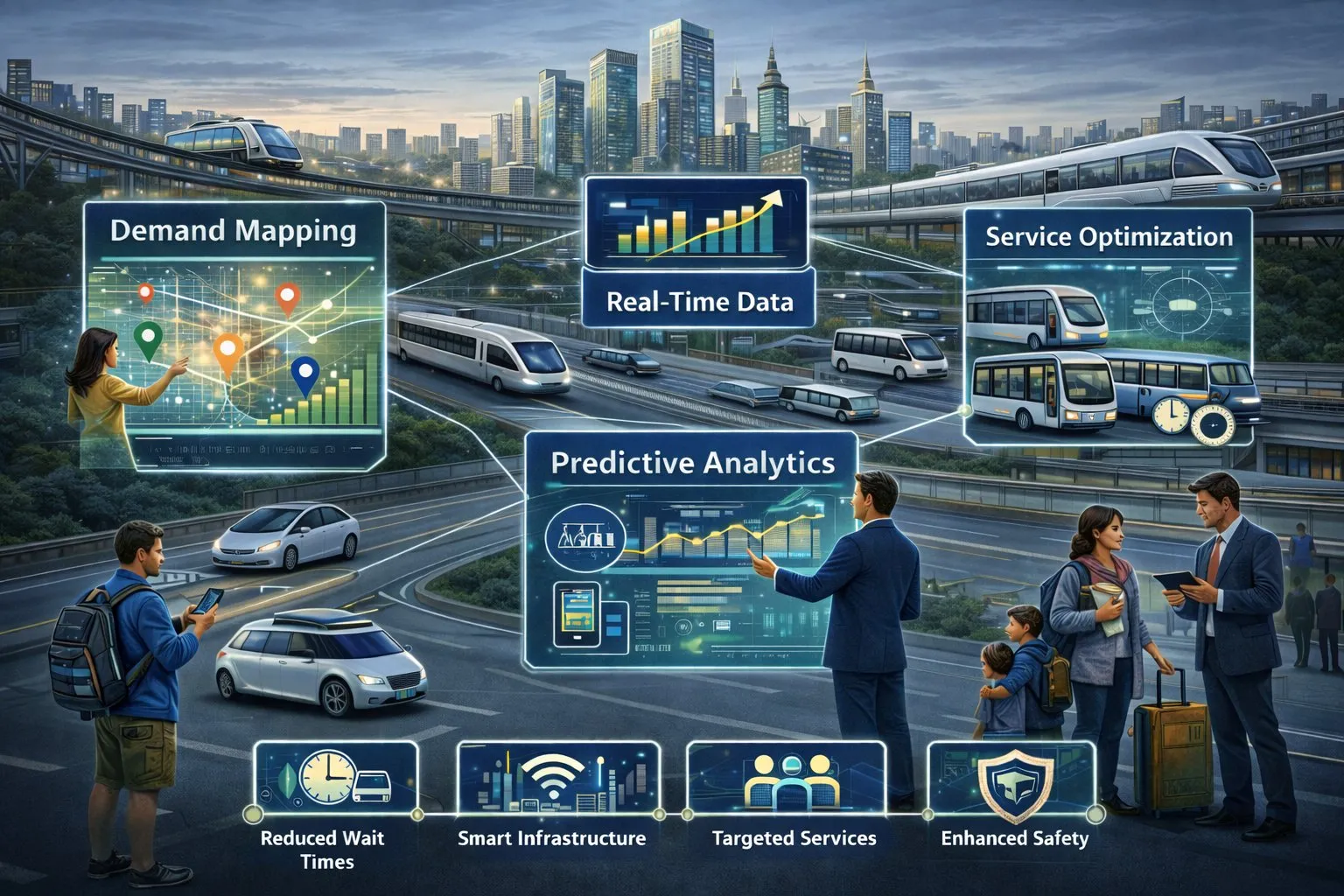
For decades, public transport planning relied on assumptions. Routes were drawn based on past usage, surveys were conducted once in a few years, and service changes were often reactive—introduced only after complaints or visible overcrowding.
Today, that approach is no longer enough.
Cities that are serious about improving ridership are shifting toward passenger intelligence—a deeper, continuous understanding of how people actually move, where demand is growing, and where the system is quietly failing to serve potential users.
Passenger intelligence doesn’t replace planning judgement. It strengthens it. It helps cities move from guessing what passengers need to knowing how demand behaves on the ground.
What Passenger Intelligence Really Means
Passenger intelligence is not just about counting riders. It’s about understanding movement patterns.
Instead of asking “how many people use this route,” cities are asking more useful questions:
- Where are passengers starting their trips?
- Where are they actually going?
- At what times does demand spike or disappear?
- Which trips are people choosing not to make by public transport?
This kind of insight goes beyond traditional ridership reports. It connects ticketing data, GPS movement, stop-level boarding, and time-based patterns to create a clearer picture of travel behaviour.
When planners understand why people travel—not just how many—they gain the ability to design services that feel relevant, reliable, and worth choosing.
Origin–Destination Data and Trip Density: Seeing the Network Clearly
One of the most valuable components of passenger intelligence is origin–destination data. It shows how passengers move across the city, not just along a single route.
Traditional planning often assumes linear travel: passengers board on one route, ride it end to end, and disembark. In reality, trips are more complex. People transfer, change modes, and travel across multiple corridors that don’t always align neatly with route structures.
When cities analyse origin–destination flows and trip density, they begin to see:
- corridors with strong demand that lack direct connectivity
- areas where passengers are making inefficient transfers
- stops that act as informal hubs without proper service support
- time windows where demand clusters but supply does not
This insight allows agencies to rethink service patterns—sometimes with small changes that have a big impact.
Platforms like RouteSync from Arena Softwares support this by translating raw passenger data into usable demand maps, helping planners visualise where movement actually concentrates across the network.
Identifying Unmet Demand and Underserved Zones
Some of the most important passenger intelligence insights come from what isn’t happening.
Low ridership in an area doesn’t always mean low demand. It often means the service is inconvenient, indirect, or unreliable. Without data, these zones remain invisible—written off as “low usage areas.”
Passenger intelligence helps uncover these blind spots.
By analysing trip density, boarding drop-offs, transfer penalties, and time-based demand gaps, cities can identify areas where people are travelling but avoiding public transport. These are often residential expansions, employment clusters, or mixed-use zones that have grown faster than the network.
Once identified, these areas become opportunities rather than liabilities. Targeted service improvements—better feeders, adjusted schedules, or more direct connections—can unlock demand that already exists but hasn’t been captured.
This approach shifts planning from reacting to complaints to proactively growing ridership.
Using Demand Data to Drive Ridership Growth
Ridership growth rarely comes from one big change. It comes from a series of small, informed decisions that improve everyday usability.
Cities using passenger intelligence effectively tend to focus on:
- aligning service frequency with real demand, not averages
- improving connectivity where trip chains break down
- reducing transfer friction at key locations
- matching vehicle capacity to actual passenger load
- adjusting service timing to reflect when people really travel
These changes may not always be visible on a city map, but passengers feel them quickly. Waiting times reduce. Transfers make more sense. Trips become predictable.
Over time, this builds trust—and trust is what brings passengers back consistently.
RouteSync supports this process by combining demand insights with operational data, allowing agencies to test scenarios and understand the impact of changes before they are rolled out.
Why Passenger Intelligence Matters More Than Ever
In most cities today, the challenge is not awareness—it’s choice. People often have alternatives, and public transport has to compete on reliability and relevance.
Passenger intelligence gives cities the ability to respond with precision instead of assumptions. It allows agencies to invest where it matters, adjust services intelligently, and demonstrate that planning decisions are grounded in real behaviour.
As expectations rise and budgets tighten, this level of insight is becoming essential—not optional.
Closure
Improving ridership is not just about adding more services—it’s about understanding how people actually move through the city. Passenger intelligence gives transport agencies that understanding, turning raw demand data into practical planning insight. With platforms like RouteSync, powered by Arena Softwares, cities can map origin–destination flows, identify unmet demand, and design services that align more closely with real travel behaviour. When planning starts with passengers, ridership growth becomes a natural outcome rather than a forced objective.
Get a passenger demand mapping demo to see how RouteSync can help your city visualise demand patterns, uncover hidden opportunities, and build services that more people choose to use.



Comments
0 messagesLeave a comment
Your email won't be published. Anonymous commenters can skip both name and email.