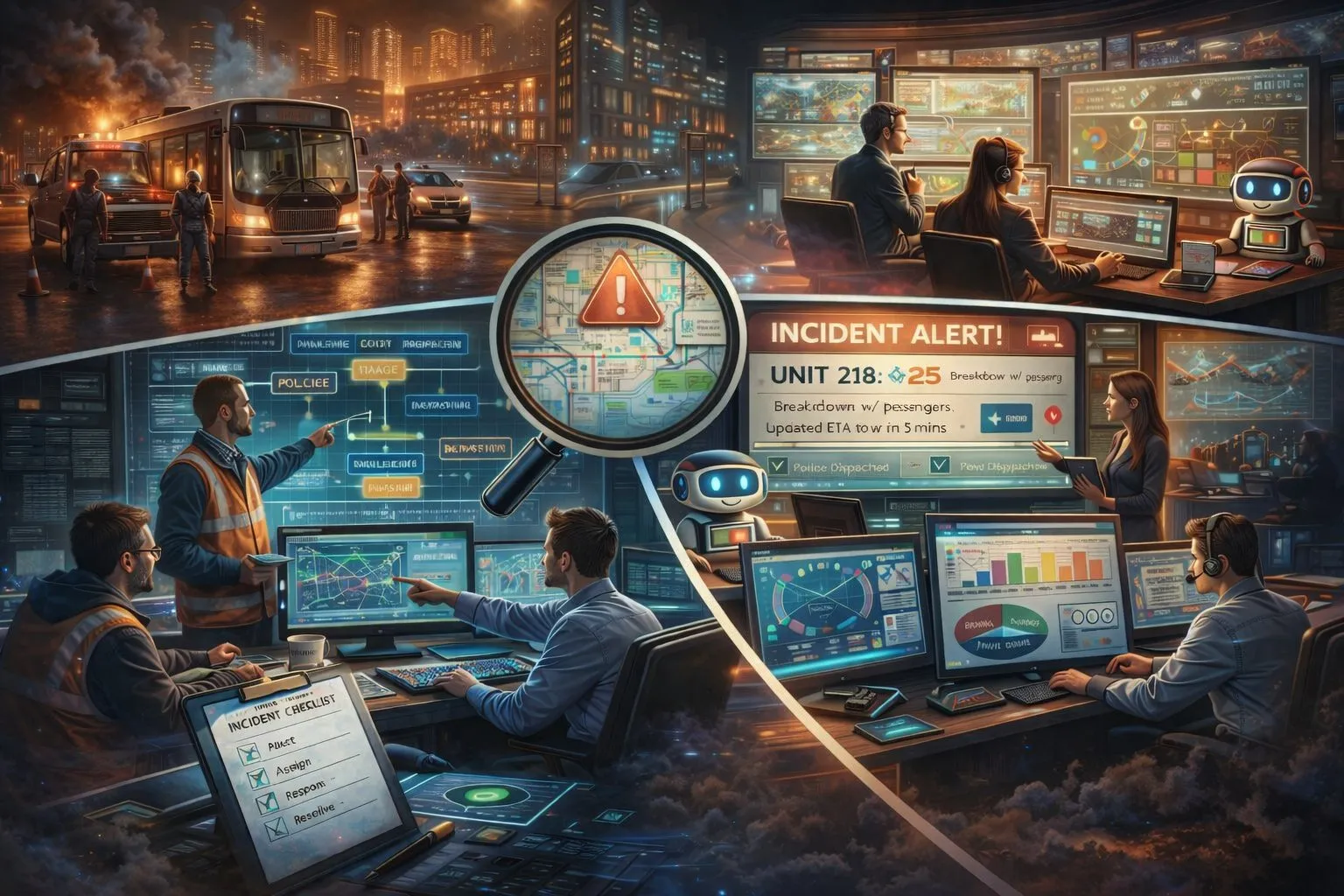
In public transport operations, incidents are inevitable. No system runs an entire day without disruption. Vehicles break down, traffic conditions change unexpectedly, drivers report issues mid-route, and occasionally small technical faults escalate into service-level problems.
What distinguishes a stable transport network from a fragile one is not the absence of incidents. It is the ability to manage them calmly, consistently, and with clear responsibility.
Incident management is often misunderstood as an alert system. In reality, it is a structured process that begins with detection but must end with resolution—and ideally, prevention.
The Types of Incidents Operators Face Every Day
Not every incident is dramatic. In fact, most operational disruptions are routine but cumulative.
- A bus stalls at a stop longer than expected.
- A vehicle deviates slightly from its assigned corridor.
- A driver reports a mechanical warning light.
- A departure is missed at the depot during peak dispatch.
Individually, these may appear minor. But when they occur repeatedly or at sensitive time windows, they destabilize service patterns. Headways collapse, recovery time disappears, and control rooms move from planned oversight to reactive firefighting.
Effective incident management begins with recognizing that small operational anomalies, if left unchecked, often become service reliability issues.
From GPS Alerts to Meaningful Signals
Modern fleets are equipped with GPS systems capable of generating real-time alerts. However, alerts by themselves do not create control.
A bus may trigger a deviation notification. Another may exceed dwell time thresholds. A third may appear stationary for an extended period. The challenge is not a lack of data—it is deciding what requires intervention and what can self-correct.
For real-time tracking to be useful in incident management, it must be linked to operational context. An extended stoppage during peak hour on a high-frequency corridor carries different implications than the same event on a low-demand feeder route.
When live vehicle data is tied directly to trip schedules, headway expectations, and route criticality, alerts become actionable. The system does not merely report movement; it highlights operational risk.
This integration is central to platforms like RouteSync from Arena Softwares, where tracking data is aligned with trip validation and service monitoring rather than displayed in isolation.
Escalation Workflows: Clarity Under Operational Pressure
Incidents create pressure. Under pressure, ambiguity causes delay.
A structured escalation workflow removes uncertainty by defining:
- who receives the initial alert
- what thresholds trigger supervisor involvement
- when depot intervention is required
- how spare vehicles are deployed
- who communicates externally if needed
Without predefined workflows, response depends on individual judgement. While experience is valuable, reliance on informal processes introduces inconsistency. A documented escalation framework ensures that similar incidents are handled in similar ways, regardless of shift or personnel. It also creates accountability and traceability—two elements that are increasingly important in performance-based contracts and regulatory oversight.
Digital systems that support escalation logic—rather than simply displaying alerts—strengthen this consistency.
Reporting and Prevention: Turning Incidents into Insight
Managing an incident in real time is only part of the responsibility. The longer-term value lies in understanding patterns.
Are breakdowns concentrated within a specific vehicle type? Are missed departures linked to one depot’s dispatch cycle? Do route deviations increase during certain traffic windows? Is peak-hour congestion regularly affecting the same corridor? Without structured reporting, incidents remain isolated events. With proper classification and logging, they become operational intelligence.
This insight allows agencies to adjust dispatch buffers, refine maintenance cycles, revisit scheduling assumptions, or improve crew coordination. Over time, the number of repeat disruptions declines—not because incidents disappear, but because root causes are addressed.
Incident Management as an Operational Discipline
It is tempting to view incident management as a technological upgrade. In practice, it is an operational discipline supported by technology.
It requires:
- timely detection
- contextual assessment
- defined escalation
- coordinated response
- structured reporting
When these elements work together, control rooms operate with greater confidence. Response becomes measured rather than improvised. Service stability improves because disruptions are contained before they spread.
Solutions such as RouteSync, powered by Arena Softwares, are designed to support this discipline by connecting tracking, trip monitoring, escalation logic, and performance reporting into a single operational environment.
Closure
Incidents are unavoidable in public transport. Unstructured responses are not.
A strong incident management framework does more than resolve breakdowns—it protects service reliability, strengthens accountability, and builds institutional learning. By moving from simple alerting to coordinated action and structured reporting, transport agencies create operations that are resilient rather than reactive.
When incident management is approached as a continuous process—detection, response, and prevention—service reliability becomes far more sustainable.
Get an incident workflow template to review how your organisation handles detection, escalation, and reporting—and identify where operational control can be strengthened.


Comments
0 messagesLeave a comment
Your email won't be published. Anonymous commenters can skip both name and email.