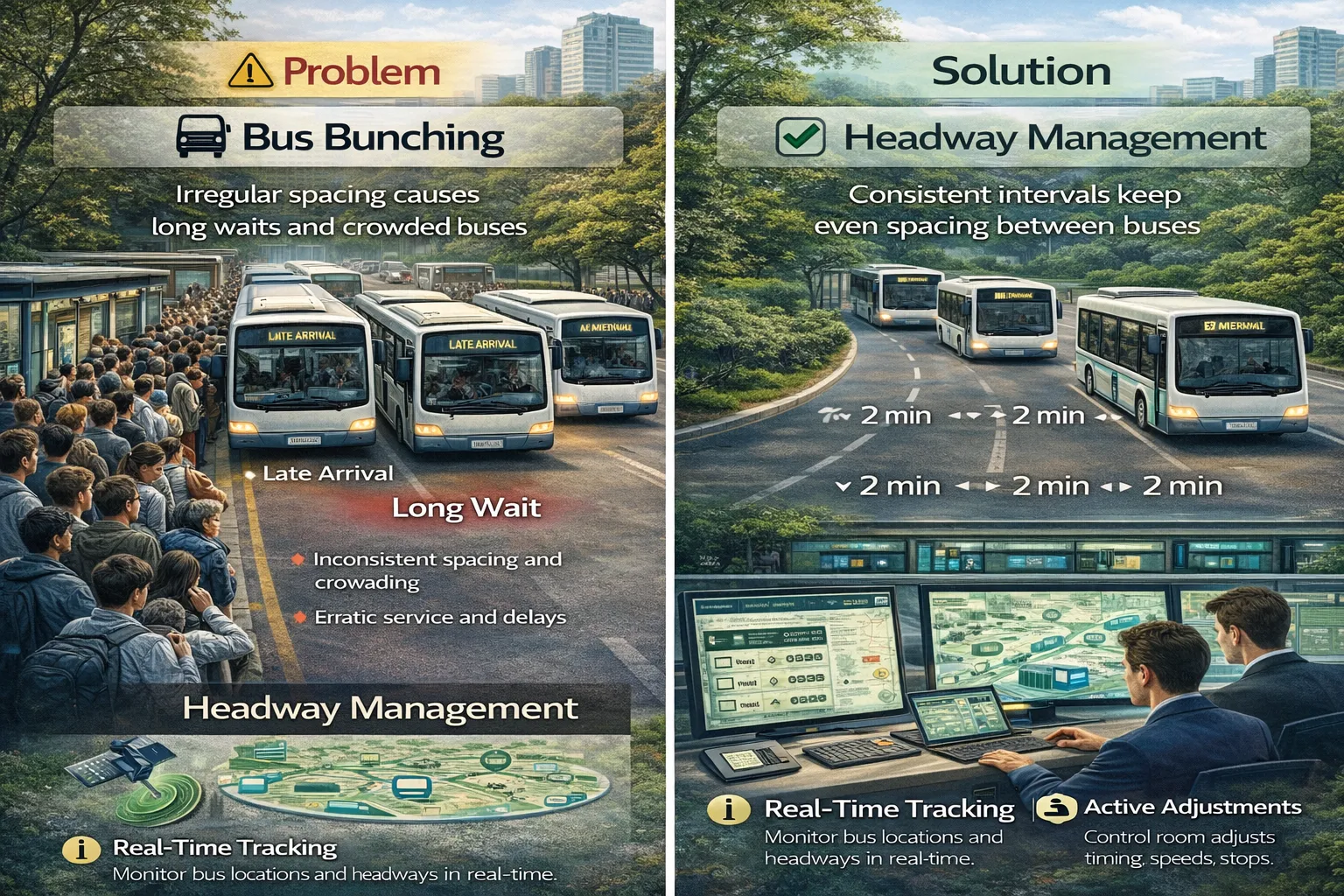
If you’ve ever waited 20 minutes for a bus and then watched two or three arrive together, you’ve experienced bus bunching—one of the most common and most frustrating problems in urban public transport. It affects commuters, drivers, and agencies in ways that go beyond inconvenience. It increases passenger complaints, makes travel times unpredictable, and causes services to feel unreliable even when the schedule looks “fine” on paper.
This is exactly why more agencies in 2026 are shifting their operational focus away from strict schedule adherence and toward something more meaningful for passengers: headway management.
Headway management is not about rewriting routes. It’s about controlling how evenly buses arrive and preventing the patterns that cause long gaps and then clustered arrivals. When done correctly, it becomes one of the most practical ways to improve reliability without adding more buses.
Headway vs Schedule Adherence: What’s the Difference?
Most bus operations are traditionally measured against the schedule: did the bus leave the depot on time, and did it reach key stops close to the planned timetable? While this matters, it doesn’t always reflect passenger reality.
Passengers don’t experience “lateness” the same way agencies measure it. What they feel is waiting time and predictability. On frequent routes, commuters rarely check the timetable—they expect a bus every 8–12 minutes. When that interval breaks, the service feels unreliable even if buses technically remain within an acceptable “late window.”
That is why headway is often a better service indicator than schedule adherence on high-frequency routes.
Schedule adherence measures how closely a bus follows a planned timetable. Headway measures the time gap between one bus and the next.
A route can be “on schedule” but still deliver poor service if headways collapse into long gaps and bunching. Headway management focuses on fixing that exact problem.
Why Bus Bunching Happens
Bus bunching is not always caused by poor planning. It often develops naturally under real-world conditions, especially in busy cities. The issue usually starts small, then grows into a chain reaction.
A bus gets delayed—maybe due to congestion, heavy boarding, a slow intersection, or a minor incident. Because it’s late, it arrives at stops with a larger crowd waiting. More passengers board, which increases dwell time, which delays it even further. Meanwhile, the bus behind it encounters fewer passengers because the first bus has already picked most of them up, so it moves faster and begins catching up.
That’s the bunching cycle.
Over time, the system starts producing:
- one overloaded, slow bus
- followed by one or two underutilized buses
- followed by a long service gap behind them
This creates exactly the passenger experience commuters complain about: nothing for 15–20 minutes, then two buses at once.
How Headway-Based Control Improves Reliability
Headway-based control works because it treats buses as part of a moving system, not as independent trips. The goal is to keep buses spaced evenly and prevent gap formation.
Instead of asking, “Is this bus on time?” headway control asks:
- How far is this bus from the one ahead?
- How far is it from the one behind?
- Is the spacing stable or collapsing?
When agencies manage these gaps actively, they prevent the bunching loop from growing. The result is a service that feels more consistent to passengers, even in congested conditions.
The best part is that headway management typically improves performance without adding additional fleet—because it fixes utilization. Once headways stabilize, overcrowding reduces, recovery time improves, and service becomes predictable again.
At Arena Softwares, RouteSync supports this by enabling agencies to track live headways across routes and identify where spacing is breaking, allowing operations teams to take corrective action before bunching spreads.
Operational Decisions That Make Headway Management Work
Headway management is not theoretical. It becomes effective only when agencies can apply real operational controls in the field. The most common and practical decisions include holding, expressing, and short-turning.
- Holding
Holding is one of the simplest headway tools. If a bus is catching up too quickly to the vehicle ahead, it may be held briefly at a stop or terminal to restore spacing. The hold time is usually small, but it protects the service pattern across the corridor.
Holding works best when applied strategically—at terminals, major stops, or timed control points—rather than randomly, because uncontrolled holding can frustrate passengers if not communicated properly.
- Expressing (Skip-Stop / Limited Stop Adjustments)
Expressing allows a delayed bus to skip a few stops temporarily to regain spacing. This can prevent it from getting trapped in heavy boarding cycles, and it reduces bunching by helping the delayed vehicle recover.
Expressing decisions need to be guided by demand and passenger impact, which is why real-time data matters.
- Short-Turns
Short-turning is used when the system needs to restore balance quickly. If one bus is severely delayed, it may be turned back early to re-enter service where demand is highest, rather than completing the full route late and dragging the system behind it.
Short-turning is one of the strongest tools for high-frequency corridors, but it must be applied carefully, with passenger communication and system-wide visibility.
Why Headway Management is a “Real Fix”, Not a Temporary Patch
Bus bunching happens in every city, including those with good route design. That’s why headway management is not an optional add-on—it is a core operational capability for any modern public transport system.
When agencies adopt headway control:
- The passenger waiting time becomes more predictable
- The load is distributed more evenly across vehicles
- Route reliability improves without increasing fleet size
- Complaints reduce because the service feels consistent
- Operations teams gain more control over service quality
It is one of the most direct ways to improve reliability without expensive infrastructure expansion.
Closing Thought
Improving bus service isn’t only about expanding routes or increasing buses. Often, the biggest improvement comes from controlling the service you already run. Headway management does exactly that—it keeps spacing stable, prevents bunching, and makes the service feel dependable.
And for passengers, that’s what matters most.
Get a Headway Strategy Assessment for Your Network
If bus bunching and uneven service gaps are affecting reliability on your routes, Arena Softwares can help you assess and improve headway control. With RouteSync, agencies can monitor real-time headways, identify collapse patterns early, and apply operational strategies like holding, expressing, and short-turning with better control.



Comments
0 messagesLeave a comment
Your email won't be published. Anonymous commenters can skip both name and email.