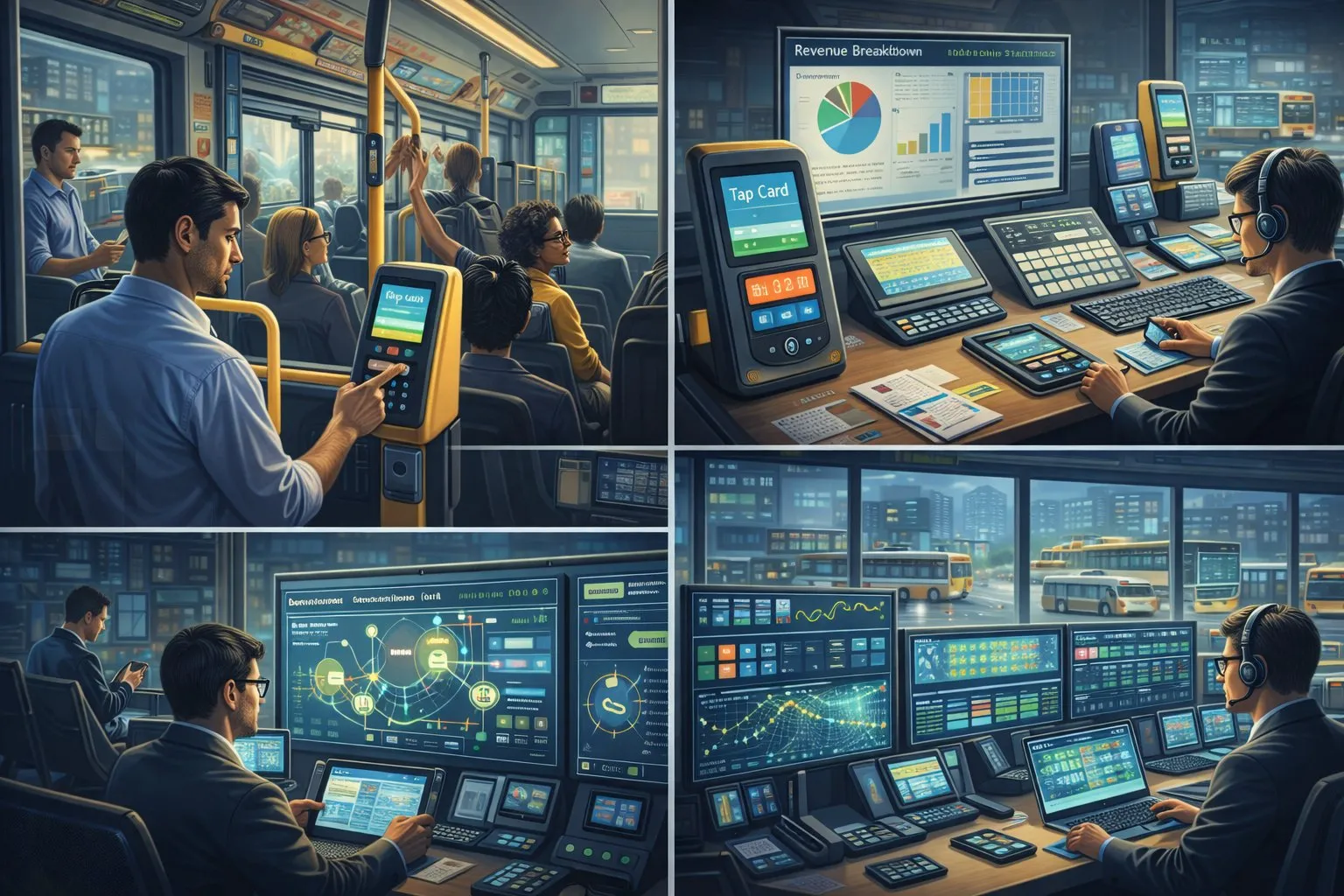
If you look at how most public transport systems are set up, you’ll notice something quite common. Ticketing and operations usually sit in different worlds.
On one side, there’s fare collection—smart cards, QR tickets, and digital payments. On the other, there’s route planning, vehicle tracking, and day-to-day operations. Both are important. But when they work separately, you only see part of the picture. And that’s exactly where many cities are starting to rethink things.
The Gap Between Ticketing and Operations
AFC systems have done a lot for public transport already. They’ve made boarding faster, reduced cash handling, and brought more transparency to revenue. From an operational standpoint, that’s a big step forward.
But most of the time, AFC stops at transactions. You know how many tickets were sold. You know how much revenue came in. But that doesn’t always tell you how well the system is actually performing.
For example, a route might show strong ticketing numbers. That sounds good—but what if those buses are overcrowded every day? Or running late? Or unevenly spaced? Ticketing data alone doesn’t always answer those questions.
What Changes When Systems Start Talking to Each Other
When AFC is linked with route tracking and fleet monitoring, you’re no longer looking at just numbers—you’re looking at patterns.
You begin to see how demand actually behaves.
Instead of just counting passengers, you can understand the following:
- where pressure is building on the network
- when demand peaks during the day
- which routes are struggling to keep up
- and where buses might be underused
This is where platforms like RouteSync from Arena Softwares come into play. They don’t replace ticketing systems—they connect them with operations.
And that changes how decisions are made.
From Transactions to Real Demand Insight
Every ticket is a small data point. On its own, it doesn’t say much. But when you look at thousands of them together—and match them with route data—it starts to tell a story.
You can see which corridors are always busy. You can spot time slots where demand suddenly rises. You can even identify stops that are doing most of the heavy lifting. It’s not something you always notice immediately. But once you start looking at it this way, the network begins to make more sense.
Planning Gets Easier (and More Accurate)
Route planning has always involved a bit of estimation. Even experienced planners rely on a mix of surveys, observations, and historical data. That’s normal. But it also means changes can lag behind real demand.
When AFC data is combined with operational data, that gap starts to shrink. Decisions become less about assumptions and more about what’s actually happening.
You might notice:
- certain trips consistently filling up faster than expected
- some routes performing well only during specific hours
- others that aren’t being used as much as planned
These aren’t dramatic discoveries, but they help fine-tune the system over time.
What It Means for Daily Operations
This kind of integration doesn’t just help planners. It affects day-to-day operations as well.
When demand and movement are visible together, it becomes easier to adjust how the system runs.
A few practical improvements usually follow:
- vehicles can be allocated more sensibly
- overcrowded routes become easier to manage
- schedules can be adjusted with more confidence
Nothing changes overnight. But gradually, the system becomes more balanced.
Why This Shift Is Happening Now
Transport systems today are under more pressure than before. Cities are growing. Passenger expectations are higher. And there’s less room for inefficiency. Running separate systems—one for ticketing, another for operations—starts to feel limiting.
That’s why many agencies are moving toward integrated platforms where everything connects: fare data, vehicle tracking, and route performance. Solutions like AFC combined with RouteSync, powered by Arena Softwares, are built around this idea. Not just collecting data, but actually using it.
Closing Thought
At a glance, fare collection and route management might seem like two different parts of the system. But in reality, they’re closely connected. When those systems start working together, public transport becomes easier to understand—and easier to improve.
And that’s really the goal. Not just to run buses, but to run them better over time.
If you're exploring how to connect AFC systems with route planning and fleet operations, you can request a demo from Arena Softwares to see how RouteSync helps bring these pieces together in a practical way.

Comments
0 messagesLeave a comment
Your email won't be published. Anonymous commenters can skip both name and email.